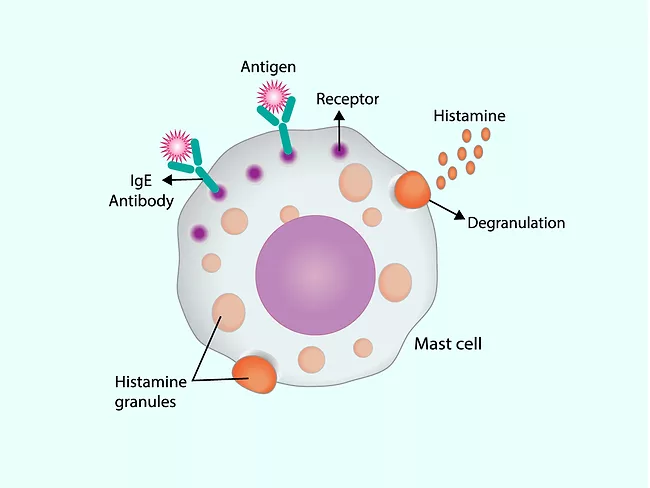
IgE is known to drive allergic disease, and omalizumab is the only approved anti-IgE antibody to date that has shown suboptimal IgE affinity and limited use in scenarios with high IgE levels.
Celldex Inc.’s KIT inhibitor, barzolvolimab, which hit its phase II endpoints in late 2023, kicking off phase III development in chronic spontaneous urticaria, offered up some impressive long-term findings at the EAACI Congress 2025, including complete responses in patients for as long as seven months after the cessation of therapy, which analysts said could position the drug as a potentially best-in-class option.
A peptide with a dual mechanism of action – it dissolves the bacterial membrane and activates the immune system – could be an effective weapon against microorganisms that have evolved ways to evade antibiotics, as superbugs do. Scientists at the University of Pennsylvania (UPenn) have designed stable synthetic peptides that activate mast cell receptors, which are cells involved in the innate and adaptive immune response. This dual approach eliminates bacteria and recruits neutrophils to finish the job.
Kyorin Pharmaceutical Co. Ltd. has out-licensed its preclinical candidate, KRP-M223, and its back-up compounds to Novartis Pharma AG in a deal worth up to $777.5 million. Under the terms, Novartis gains an exclusive worldwide license to develop, manufacture and commercialize Kyorin-discovered KRP-M223.
Kyorin Pharmaceutical Co. Ltd. has out-licensed its preclinical candidate, KRP-M223, and its back-up compounds to Novartis Pharma AG in a deal worth up to $777.5 million. Under the terms, Novartis gains an exclusive worldwide license to develop, manufacture and commercialize Kyorin-discovered KRP-M223.
When undertaking a study on allergen-induced anaphylaxis in mice, researchers have found that not only the immune but also the nervous system may potentially play a part in the anaphylactic response. In their study published March 17, 2023, in Science Immunology, researchers from Duke University Medical Center reported that mice undergoing anaphylaxis displayed an “extended posture behavior” similar to the one that mice exhibit when exposed to high temperatures.
It has been demonstrated that stem cell factor (SCF) and its receptor KIT play key roles in the differentiation, proliferation, survival, migration and activation of mast cells, which in turn play a central role in the development of IgE-mediated allergic diseases, including allergic urticaria and food allergy.
Mas-related G-protein coupled receptor X2 (MRGPRX2) is expressed particularly on mast cells and its activation leads to the mast cell degranulation with release of inflammatory mediators.
DUBLIN – Could a tyrosine kinase inhibitor approved for treating canine cancer offer clinical benefits in Alzheimer’s disease? That’s the bold claim AB Science SA is making, after unveiling top-line data from a phase IIb/III trial in which it reported that a subgroup of patients on a twice daily 4.5-mg/kg dose of oral masitinib experienced “a significant treatment effect” as compared with placebo after 24 weeks.