A research team from Pusan National University has developed a novel deep learning model coined Moglo-Net, designed to enable three-dimensional reconstruction of images from hand-held ultrasound procedures.
Lunit Inc. is the latest South Korean firm to gain the U.S. FDA’s 510(k) clearance for Lunit Insight DBT, its artificial intelligence (AI)-powered breast cancer diagnostic tool that analyzes digital breast tomosynthesis (DBT) images, boosting its efforts to enter the U.S. market. The company also reported that it secured $150 million in a public offering.
Artificial intelligence (AI) is in full development, and advances are already used in many fields, including medicine. In oncology, these tools can identify a tumor in an image with 99% accuracy. But they can also miss it if the algorithm was not developed with the right data or the correct decisions. The 2023 European Society for Medical Oncology (ESMO) Congress brought together in Madrid doctors and deep learning experts to discuss the challenges and advances of AI in this area. And what’s better than asking an AI what its trainer has told it about AI?
Springboarding off the success of its AI-based imaging software for cancer detection, the deep learning-based artificial intelligence (AI) company Lunit Inc. has another AI software, called the Lunit Scope, up its sleeve for which it hopes to gain U.S. FDA approval by 2025.
Springboarding off the success of its AI-based imaging software for cancer detection, the deep learning-based artificial intelligence (AI) company Lunit Inc. has another AI software, called the Lunit Scope, up its sleeve for which it hopes to gain U.S. FDA approval by 2025.
A research team from Leipzig University, the Max Planck Institute and Heidelberg University, all in Germany, devised a new segmentation algorithm for stroke lesions that improves upon previous methods. They used machine-learning models to effect CT image segmentation in the early stages of acute stroke. The research team published their findings on the fully convolutional graph network in July in the Journal of Medical Imaging.
A research team from Leipzig University, the Max Planck Institute and Heidelberg University, all in Germany, devised a new segmentation algorithm for stroke lesions that improves upon previous methods. They used machine-learning models to effect CT image segmentation in the early stages of acute stroke. The research team published their findings on the fully convolutional graph network in July in the Journal of Medical Imaging.
ArteraAI Inc. released data from a study it said validates the first-ever artificial intelligence (AI)-derived biomarker predicting the benefit of androgen deprivation therapy (ADT) for stripping prostate cancer of the testosterone it requires to grow.
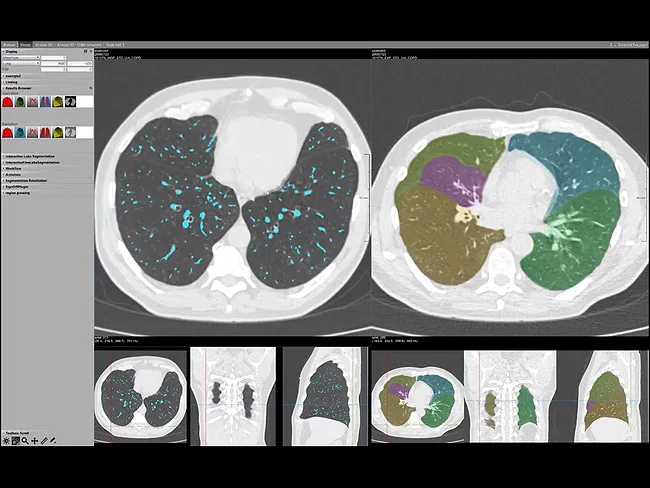
Thirona BV has been awarded $2.73 million in funding from the European Innovation Council (EIC) to fast-track the development of its artificial intelligence (AI)-based lung platform to analyze chest CT imaging. In competition with 554 other submissions, Thirona was one of 51 innovative technology companies awarded the EIC accelerator program grant, the total budget for which is €261 million (US$286.28 million) in 2023.
Artificial intelligence (AI) continues to entice. On the exhibition floor at the 2023 Congress of the European Academy of Neurology, one company’s booth featured “Mindart” technology. A passersby could answer a short series of prompts, and get a unique image based on the input made by generative AI. Entertainment aside, medically speaking, AI applications “are still research,” Riccardo Soffietti told his audience at one of several sessions devoted to AI. “But obviously, research is the future.”