Location, location, location. While location is as important in manufacturing as it is in buying a home, it could become even more so for drug companies when, and if, the global biopharma sector tariff U.S. President Donald Trump continues to tease becomes a reality. In the shadow of the impending tariff, the FDA is working on a draft framework, the two-phase FDA PreCheck, to make it faster and easier for biopharma companies to relocate their manufacturing to the U.S.
After shutting down manufacturers’ efforts last year to offer the mandated 340B discounts on outpatient prescription drugs as a rebate rather than an up-front price, the U.S. Health Resources and Services Administration (HRSA) is now inching the rebate door open for drugs that were selected for the first round of Medicare price negotiations.
President Donald Trump sent letters July 31 to the CEOs of 17 major drug manufacturers doing business in the U.S., giving them 60 days to comply with his May 12 executive order (EO) on most-favored-nation (MFN) pricing. The EO appealed to drug companies to undertake MFN pricing voluntarily to end the freeloading in which other developed countries pay, on average, three times less than Americans are charged for the same medicines.
The U.K. government has doubled the rate that pharmaceutical companies must repay on sales of branded drugs, under the statutory rebate scheme, to a record 31.3%. Only 1-2% of total sales of branded drugs fall under the statutory scheme, but the increase is seen as a sign that an ongoing review of the voluntary scheme is not going well.
The row between pharma companies and the U.K. government over rebates has intensified, with the Association of the British Pharmaceutical Industry calling up its members to speak on the record, as it ramps up the campaign against paying back over 23% on sales of branded drugs.
The U.S. Trade Representative (USTR) is asking for help in its search for “freeloaders” that refuse to shoulder their share of the cost of biopharma R&D.
The U.S. Department of Health and Human Services (HHS) put biopharma companies on notice May 20: It’s time to commit to reducing prescription drug prices to reflect most-favored-nation (MFN) pricing in accordance with President Donald Trump’s May 12 executive order. HHS said it expects manufacturers to commit to aligning their U.S. prices for all brand products across all markets that don’t currently have generic or biosimilar competition with the lowest price of a set of economic peer countries.
Recognizing the potential legal challenges to U.S. President Donald Trump’s executive order calling for most-favored-nation (MFN) prescription drug pricing and the limits of that order, several congressional Democrats introduced a bill in both the House and Senate May 14 that could make MFN pricing the law of the land and extend it to both government health programs and private insurance.
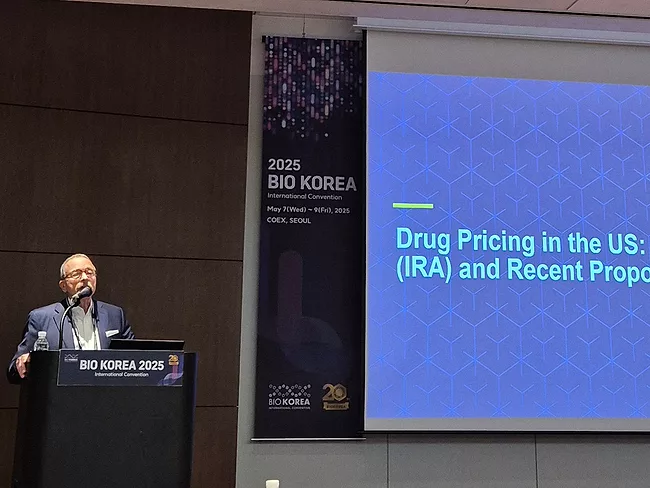
Ongoing policy issues in the U.S., including the Inflation Reduction Act and recent proposals under President Donald Trump’s administration, have wide ranging implications for the global biopharmaceutical industry, speakers at Bio Korea 2025 said May 8, including a heightened need for all biotechs to draft regulatory strategies.
Korean pharmaceutical stocks rose across the board May 13, a day after U.S. President Donald Trump signed off on the most favored nation executive order, a drug pricing policy expected to benefit biosimilar makers in the U.S., according to Celltrion Inc.