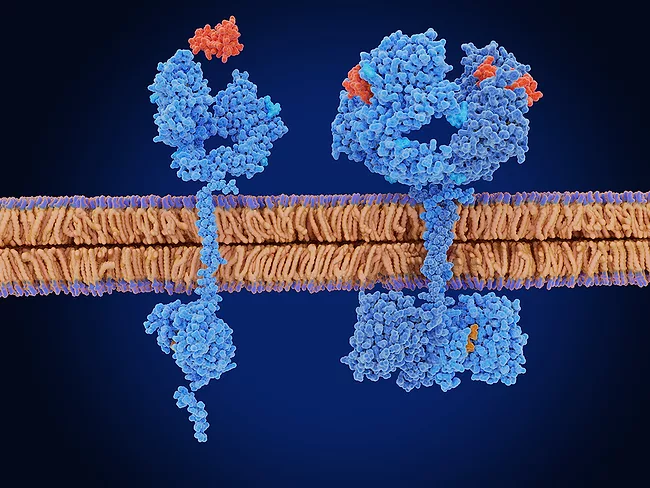
Shanghai Lisen Imprinting Pharmaceutical Technology Co. Ltd. has disclosed EGFR (HER1; erbB1) inhibitors reported to be useful for the treatment of small-cell lung (SCLC) and l lung cancer (NSCLC).
Researchers from Jiangsu Hansoh Pharmaceutical Group Co. Ltd. presented the discovery and preclinical evaluation of novel EGFR(T790M/C797S) inhibitors for the treatment of mutant non-small-cell lung cancer (NSCLC).
Mirati Therapeutics Inc.’s cancer treatment Krazati (adagrasib) is having a tough time outside the U.S. The EMA’s Committee for Medicinal Products for Human Use (CHMP) came out with a negative opinion on an MAA for treating KRAS G12C-mutated advanced non-small-cell lung cancer (NSCLC). The ruling came with a flurry of positive CHMP opinions for companies, including Abbvie Inc., Beigene Ltd. and the Janssen Pharmaceutical Cos., plus a mixed result for Ipsen SA after a stumble earlier this week.
Circle Pharma Inc. has selected CID-078 as its first clinical development candidate. CID-078 is an orally bioavailable macrocycle with dual cyclin A and B inhibitory activity that drives synthetic lethality in multiple tumor types.
Kelun-Biotech Biopharmaceutical Co. Ltd. raised HK$1.36 billion (US$174 million) in an IPO in Hong Kong to support its push into the increasingly competitive antibody-drug conjugate (ADC) market in China.
South Korean pharmaceutical giant Yuhan Corp. gained Korea’s MFDS approval to expand indications for its potent oral third-generation tyrosine kinase inhibitor Leclaza (lazertinib) as a first-line treatment for EGFR T790M mutation-positive non-small-cell lung cancer (NSCLC).
The trophoblast cell surface antigen 2 (TROP2) class chalked mix news by way of Astrazeneca plc and Daiichi Sankyo Co. Ltd. as the pair disclosed phase III data from the closely watched Tropion-Lung 1 trial with datopotamab deruxtecan (dato-dxd) against non-small-cell lung cancer.
The FDA has cleared C4 Therapeutics Inc.’s IND application for CFT-8919, an orally bioavailable Bidac (bifunctional degradation activating compound) degrader designed to be potent and selective against EGFR L858R for non-small-cell lung cancer (NSCLC).
South Korean pharmaceutical giant Yuhan Corp. gained Korea’s MFDS approval to expand indications for its potent oral third-generation tyrosine kinase inhibitor Leclaza (lazertinib) as a first-line treatment for EGFR T790M mutation-positive non-small-cell lung cancer (NSCLC).