Medtronic plc has launched a single-use device for outpatient-based treatment of chronic, obstructive Eustachian tube dysfunction (ETD). Medtronic’s FDA-approved Nuvent system is a manually controlled balloon catheter for insertion into the Eustachian tube canal. Once pressurized, the balloon expands and dilates the Eustachian tube canal to relieve symptoms of ETD.
The FDA has approved Medtronic plc’s next-generation sacral neuromodulation (SNM) system, Interstim X, giving patients a recharge-free option with a 10-year+ lifespan. This newest member of the Interstim portfolio joins the rechargeable Interstim Micro as a treatment for overactive bladder (OAB), chronic fecal incontinence (FI) and nonobstructive urinary retention.
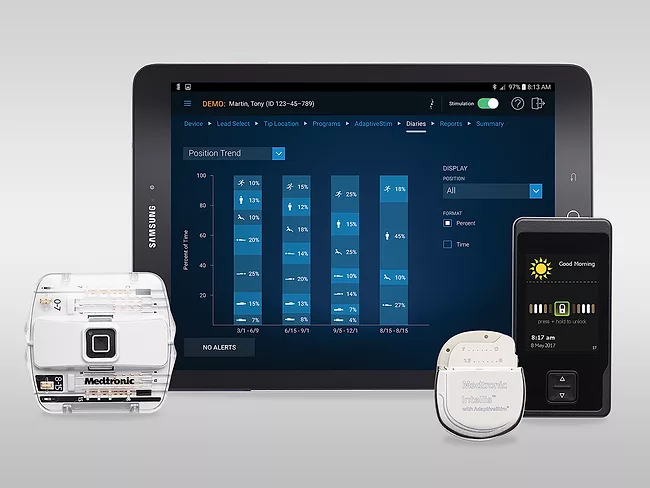
Medtronic plc received FDA premarket approval Friday for use of its Intellis rechargeable and Vanta recharge-free neurostimulators in patients with diabetic peripheral neuropathy (DPN), suddenly tripling the number of spinal cord stimulators approved for the indication. Medtronic’s implantable spinal cord stimulators (SCS) now join Nevro Corp.’s HFX, which has had the distinction since July 2021 of being the only device with FDA approval for DPN, also known as painful diabetic neuropathy (PDN).
The FDA announced a class I recall of the Medtronic Hawk One directional atherectomy catheter system due to more than 160 reports of problems with the device’s guidewire. The catheter tip could break or separate when the guidewire prolapses, a problem that is associated with 55 injuries and no deaths, but the recall affects more than 95,000 units.
Medtronic plc released initial results showing meaningful pain relief using differential target multiplexed (DTM) spinal cord stimulation (SCS) endurance therapy, a lower-energy form of its DTM SCS treatment for overall, back or leg pain. At three months, patients in the on-label, prospective, multicenter study reported that their overall pain was about half what it was at the start of the study, measured by a 3.9 cm reduction on the 10 cm Visual Analog Scale (VAS) vs. 7.8 cm at baseline. Patients in the study also reported an average decrease in back and leg pain or 4.3 cm and 5.0 cm, respectively. Medtronic plans to offer the DTM SCS endurance therapy on its rechargeable Intellis and primary cell Vanta platforms.
The existence of prior art isn’t always readily evident when companies in the device and diagnostic spaces file patent applications with the U.S. Patent and Trademark Office (PTO). As it turns out, literature describing that prior art need not be widely distributed to invalidate a patent as Quest Diagnostics Inc., of Secaucus, N.J., recently discovered, an object lesson for all in the med-tech space that research for prior art must be exhaustive if a patent is to hold up over time.
Medtronic plc continued its aggressive acquisition strategy today with the announcement of an agreement to purchase Affera Inc. Medtronic Chairman and CEO Geoff Martha revealed in a presentation on Jan. 10 at the virtual edition of the J.P. Morgan Healthcare Conference that his company was paying $925 million for the cardiac mapping and navigation company. The total reflects $250 million in payments assuming Affera meets “contingent considerations.”
FDA recalls are fairly commonplace events and infrequently require any field corrections of inventory on the market, but Puritan-Bennett Corp. has asked customers to quarantine 135 of the company’s 980 series ventilators due to assembly problems that could cause the devices to cease operating.
Glaciers are known to move slowly, but so is government, and the FDA needed seven years to make effective an order that cerebrospinal fluid shunts be deemed class II devices. The classification was applicable as of Aug. 22, 2014, in connection with a de novo petition filed by no less than industry colossus Medtronic plc, of Dublin, in a process that began in 2012, possibly earlier.
Some U.S. FDA warning letters are mostly about documentation, but the key consideration in the widely publicized Dec. 9 FDA warning letter to Dublin-based Medtronic plc seems to be whether Medtronic had a proper understanding of the risk created by malfunctioning infusion pump retainer rings. That difference of opinion regarding risk took a significant bite out of the company’s shares and boosted the fortunes of its rivals in the diabetes space, a cautionary tale regarding the hazards associated with a failure to understand how the FDA sees the risk of device malfunction. The FDA had reported in October 2021 a pair of recalls of Medtronic’s Minimed insulin pumps, although one of the issues cited was related to cybersecurity concerns. The two recalls affected nearly half a million units combined, and could have significantly affect access for some patients.