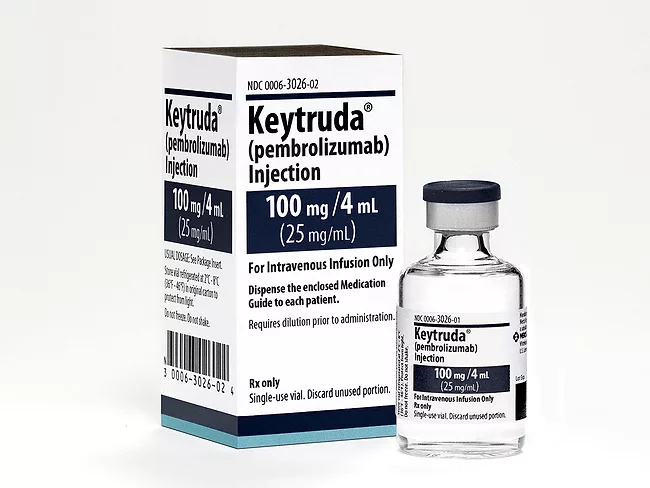
The FDA’s Oncologic Drugs Advisory Committee voted 6-2 April 29 to recommend withdrawing accelerated approval for Merck & Co. Inc.’s Keytruda (pembrolizumab) as a third-line treatment for a subgroup of patients with recurrent locally advanced or metastatic gastric or gastroesophageal junction cancer. The vote was based on FDA assurances that, if it withdrew the approval, it would work with Merck to delay the withdrawal or set up an access program to ensure the estimated 1,000 patients who are beyond first-line treatment could still get Keytruda.
In the final part of its three-day meeting on accelerated approvals granted to anti-PD-1/PD-L1 antibodies, the FDA’s Oncologic Drugs Advisory Committee (ODAC) voted unanimously to continue the accelerated approval for Merck & Co. Inc.’s Keytruda (pembrolizumab) as a therapy for patients with advanced hepatocellular carcinoma (HCC) who have been previously treated with sorafenib (Nexavar, Bayer AG).
If the FDA follows the advice of its Oncologic Drugs Advisory Committee (ODAC), both Keytruda and Tecentriq will remain on the U.S. market, for the time being, with accelerated approval as first-line treatments for certain patients with advanced or metastatic urothelial carcinoma. The committee voted 5-3 April 28 to recommend continuing accelerated approval for Merck & Co. Inc.’s Keytruda (pembrolizumab) and 10-1 for maintaining the accelerated approval of the Roche Group’s Tecentriq (atezolizumab) until the final data come in from a confirmatory trial that’s expected to be completed next year.
As part of a U.S. FDA evaluation of confirmatory trials for anti-PD-1/PD-L1 antibodies, the agency’s Oncologic Drugs Advisory Committee (ODAC) is being asked this week to consider whether three blockbuster biologics should continue to be available for certain cancer indications for which they received accelerated approval. At question is whether the data from the confirmatory trials for the Roche Group’s Tecentriq (atezolizumab), Merck & Co. Inc.’s Keytruda (pembrolizumab) and Bristol Myers Squibb Co.’s Opdivo (nivolumab) has proved sufficient benefit in particular indications and, if not, whether alternative or ongoing trials could do so.
Oncology drugs that have racked up a number of indications through accelerated approvals are losing some of those indications as the result of an FDA industrywide evaluation of confirmatory trials that didn’t back up the approvals.
The latest global regulatory news, changes and updates affecting biopharma, including: CBO model touts savings of H.R. 3; FDA to ODAC: Are data ripe for 2nd TNBC Keytruda approval?; Fifth Circuit reiterates no liability remedy for generics; Consultant faces insider trading charges.
Probably no one was surprised by the FDA’s recent nod for the combination of Alameda, Calif.-based Exelixis Inc.’s tyrosine kinase inhibitor, Cabometyx (cabozantinib), which targets MET, AXL and VEGF, and PD-1 drug Opdivo (nivolumab) from Bristol Myers Squibb Co. as a first-line treatment for advanced renal cell carcinoma (RCC), but investors may feel less confident about the odds for the pairing in a competitive space.
PERTH, Australia – Sydney-based Immutep Ltd. announced that Glaxosmithkline plc is discontinuing a phase II ulcerative colitis trial of its anti-lymphocyte activation gene-3 cell-depleting monoclonal antibody, derived from Immutep’s IMP-731 antibody that GSK licensed in 2010.
PERTH, Australia – Sydney-based Immutep Ltd. announced that partner Glaxosmithkline plc is discontinuing a phase II ulcerative colitis trial of its anti-lymphocyte activation gene-3 (LAG-3) cell-depleting monoclonal antibody, derived from Immutep’s IMP-731 antibody that GSK licensed in 2010.