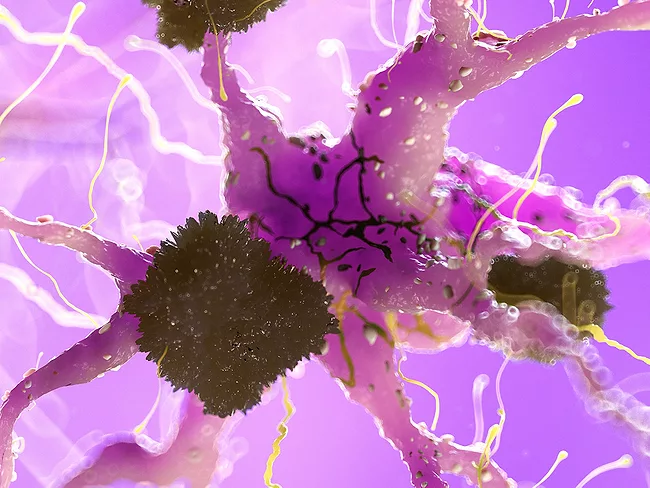
Just over a month after emerging from stealth and disclosing a $150 million series A, Korsana Biosciences Inc. is making the leap to the public market via a merger with Cyclerion Therapeutics Inc. The agreement, which is backed by a $370 million private placement from Korsana’s investors, solidly positions the newly merged company as it heads toward the clinic with KRSA-028, a next-generation shuttled antibody targeting amyloid beta for the treatment of Alzheimer’s disease, and builds out a pipeline of neurodegenerative disease candidates.
Just over a month after emerging from stealth and disclosing a $150 million series A, Korsana Biosciences Inc. is making the leap to the public market via a merger with Cyclerion Therapeutics Inc. The agreement, which is backed by a $370 million private placement from Korsana’s investors, solidly positions the newly merged company as it heads toward the clinic with KRSA-028, a next-generation shuttled antibody targeting amyloid beta for the treatment of Alzheimer’s disease, and builds out a pipeline of neurodegenerative disease candidates.
If one could sweep the brain clean and send the toxic substances that drive neurodegeneration to the recycling bin, perhaps one could treat Alzheimer’s disease. Researchers at the Chinese Academy of Sciences propose a new therapeutic strategy that uses synthetic peptides that bind to amyloid-β (Aβ) and direct it toward lysosomes. In addition, researchers at the Washington University School of Medicine in St. Louis have genetically modified astrocytes in vivo to express chimeric antigen receptors (CARs) that recognize and phagocytose Aβ plaques.
If one could sweep the brain clean and send the toxic substances that drive neurodegeneration to the recycling bin, perhaps one could treat Alzheimer’s disease (AD). Researchers at the Chinese Academy of Sciences propose a new therapeutic strategy that uses synthetic peptides that bind to amyloid-β (Aβ) and direct it toward lysosomes. In addition, researchers at the Washington University School of Medicine in St. Louis have genetically modified astrocytes in vivo to express chimeric antigen receptors (CARs) that recognize and phagocytose Aβ plaques.
With rumors regarding a couple of potential mega-mergers making the rounds, the week of the annual J.P. Morgan Healthcare Conference kicked off with the official disclosure of some billion-dollar collaborations, leading with Abbvie Inc.’s exclusive licensing deal with Remegen Co. Ltd. for PD-1/VEGF-targeted bispecific antibody RC-148.
With rumors regarding a couple of potential mega-mergers making the rounds, the week of the annual J.P. Morgan Healthcare Conference kicked off with the official disclosure of some billion-dollar collaborations, leading with Abbvie Inc.’s exclusive licensing deal with Remegen Co. Ltd. for PD-1/VEGF-targeted bispecific antibody RC-148.
Akeso Inc. has received clearance from China’s National Medical Products Administration (NMPA) to initiate clinical trials with AK-152 for Alzheimer’s disease.
A little-known tissue composed of a cluster of immune cells could offer novel insights into the development of neurological disorders. Meninges' immune system changes with age and neurodegeneration. Are they protecting the brain or fueling disease?
The difference between the origin of Alzheimer's disease (AD) and its symptoms is an obstacle to finding effective treatments. Scientists focused on amyloid-β (Aβ) plaques and tau aggregates to slow neurodegeneration and cognitive decline. Without identifying what causes AD, approved treatments do not provide much benefit.
A little-known tissue composed of a cluster of immune cells could offer novel insights into the development of neurological disorders. Meninges' immune system changes with age and neurodegeneration. Are they protecting the brain or fueling disease? Mapping and analyzing the so-called ectopic lymphoid structures (ELSs) in the meninges at different ages in preclinical models of neurodegenerative diseases such as Alzheimer's may help clarify whether they are good, bad, or ugly, as in the iconic film by Sergio Leone.