The “showdown” at the American Society of Clinical Oncology (ASCO) meeting foreseen by one analyst between breast cancer drugs from Gilead Sciences Inc. and Astrazeneca plc with partner Daiichi Sankyo Co. Ltd. didn’t quite materialize. Or the showdown happened, but turned out more nuanced than a one-to-one, high-noon gunfight on Main Street. Gilead ended considerable suspense June 4 by offering at ASCO phase III data from the Tropics-02 study with Trodelvy (sacituzumab govitecan), expectations for which already had grown lukewarm. Astrazeneca and Daiichi dazzled the next-day meeting with phase III data from the Destiny-Breast04 (DB04) study with Enhertu (fam-trastuzumab deruxtecan).
Less than a year after winning approval in China for the first domestically developed antibody-drug conjugate (ADC), Remegen Co. Ltd. raised ¥2.6 billion (US$410 million) and picked up a listing on the Shanghai STAR market to support further work on its monoclonal antibodies and ADCs.
Less than a year after winning approval in China for the first domestically developed antibody-drug conjugate (ADC), Remegen Co. Ltd. raised ¥2.6 billion (US$410 million) and picked up a listing on the Shanghai STAR market to support further work on its monoclonal antibodies and ADCs.
When, late last year, Daiichi Sankyo Co. Ltd. won breakthrough status from the FDA for HER3-targeting lung cancer prospect patritumab deruxtecan, Wall Street began taking stock of other candidates in the space. “The winning strategy to therapeutically target HER3 remains to be seen,” noted a recent paper in Clinical Cancer Research, “but HER3 is a promising drug target, and the era of drugging the ‘undruggables’ has already started.”
Monoclonal antibodies are already a pillar of cancer therapy, and cancer makes up the largest indication of FDA-approved antibodies, with almost 40% of the total. At the 2021 European Society of Medical Oncology (ESMO) Congress, Elena Garralda predicted that engineered versions of classical antibodies will soon join them on their pedestal.
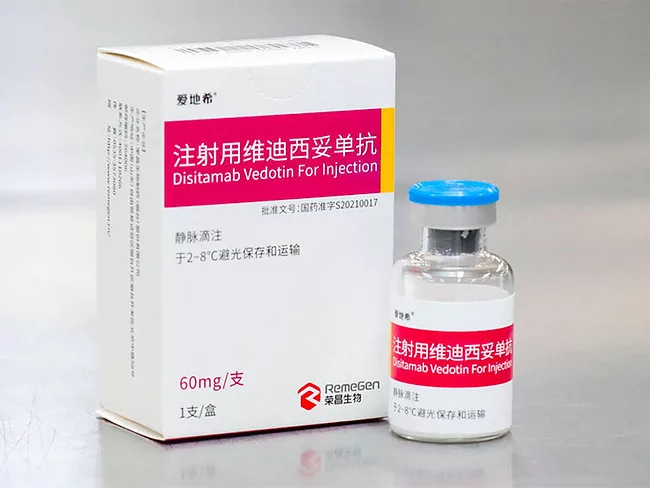
Seagen Inc. and Remegen Co. Ltd. will collaborate to exclusively develop and commercialize disitamab vedotin, a humanized antibody-drug conjugate (ADC) targeting HER2, giving Remegen the chance to earn up to $2.4 billion in total milestone payments.
Astrazeneca plc and Daiichi Sankyo Co. Ltd. are pushing forward with a challenge to Roche Holding AG with breast cancer drug Enhertu (trastuzumab deruxtecan) after it demonstrated superiority over the Swiss firm’s Kadcyla (trastuzumab emtansine) in a head-to-head trial.
Seagen Inc. and Remegen Co. Ltd. will collaborate to exclusively develop and commercialize disitamab vedotin, a humanized antibody-drug conjugate (ADC) targeting HER2, giving Remegen the chance to earn up to $2.4 billion in total milestone payments.
Remegen Ltd.’s HER2-targeted disitamab vedotin became the first domestic antibody-drug conjugate (ADC) to win marketing approval in China, just three months after the company scored its first NDA approval in China for its lupus drug Tai’ai (telitacicept). The news sent Remegen’s share price (HKEX:9995) up 12.8% in Hong Kong on June 9.
Byondis BV is gearing up for a U.S. filing of an antibody-drug conjugate (ADCs) in advanced HER2-positive breast cancer, but CEO Marco Timmers has grand plans to partner up with big pharma and expand into other diseases.