BioWorld. Link to homepage.

Clarivate
  • BioWorld
  • BioWorld Science
  • BioWorld Asia
  • Data Snapshots
    • Biopharma
    • Medical technology
    • Infographics: Dynamic digital data analysis
    • Index insights
    • NME Digest
  • Special reports
    • Infographics: Dynamic digital data analysis
    • Trump administration impacts
    • Med-tech outlook 2026
    • Under threat: mRNA vaccine research
    • BioWorld at 35
    • Biopharma M&A scorecard
    • Bioworld 2025 review
    • BioWorld MedTech 2025 review
    • BioWorld Science 2025 review
    • Women's health
    • China's GLP-1 landscape
    • PFA re-energizes afib market
    • China CAR T
    • Alzheimer's disease
    • Coronavirus
    • More reports can be found here

BioWorld. Link to homepage.

  • Sign In
  • Sign Out
  • My Account
Subscribe
BioWorld - Monday, May 4, 2026
Home » APOE4

Articles Tagged with ''APOE4''

Martin Tolar, CEO, Alzheon

Alzheon nabs $100M in series E to advance oral Alzheimer’s drug

June 20, 2024
By Marian (YoonJee) Chu
Alzheon Inc. has raised $100 million in a series E financing round to push its oral drug candidate for early Alzheimer’s disease (AD), ALZ-801 (valiltramiprosate), through a late-stage, Apolloe4 study.
Read More
Silhouette of head and brain with DNA double helixes
Neurology/psychiatric

Two copies of APOE4 cause genetic form of Alzheimer’s

May 6, 2024
By Anette Breindl
Based on its analysis of a large cohort of individuals homozygous for the ε4 variant of apolipoprotein E (APOE4), a multinational team of researchers is arguing that homozygosity for APOE4 should be considered a genetic form of Alzheimer’s disease. However, not everyone agrees that the findings warrant reclassifying APOE from risk factor to causal gene. Currently, APOE4 is classified as the strongest risk factor for developing AD. Another variant, the APOE2 variant, is protective, while APOE3 is neutral.
Read More
Neurology/psychiatric

Two copies of ApoE4 cause genetic form of Alzheimer’s

May 6, 2024
By Anette Breindl
Based on its analysis of a large cohort of individuals homozygous for the ε4 variant of apolipoprotein E (ApoE4), a multinational team of researchers is arguing that homozygosity for ApoE4 should be considered a genetic form of Alzheimer’s disease (AD).
Read More
Tree in the shape of human head losing leaves
Neurology/Psychiatric

Much remains mysterious about cognitive decline

Feb. 10, 2023
By Anette Breindl
The shunt towards, or away from, cognitive decline may happen decades before such decline becomes clinically evident. And known risk factors explain very little of that decline. That is the conclusion reached by researchers from the Ohio State University, who published their results in the Feb. 8, 2023, issue of PLOS ONE.

In their analysis, the team looked at both the absolute level of cognitive function in about 7,000 participants of the U.S. Health and Retirement Study at age 54, and at the decline in cognitive function from age 54 to 85. The study participants that were analyzed were born between 1931 and 1941. The results were reminiscent of the adage that the way to make a silk purse out a sow’s ear is to start with a silk sow.
Read More
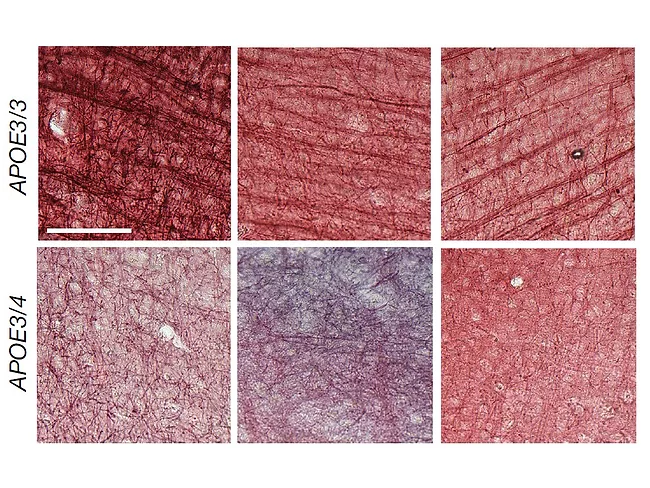
Brain samples of people with APOE3/4 vs. APOE3/3
Neurology/Psychiatric

APOE4 allele reduces myelination in Alzheimer’s disease

Nov. 16, 2022
By Mar de Miguel
Carrying the apolipoprotein E4 allele (APOE4), and not the APOE3 variant, is the strongest risk factor for developing Alzheimer’s disease (AD). But the underlying mechanism has remained elusive. Now, researchers at MIT and Mount Sinai have found that in brains carrying the APOE4 allele, lipid and cholesterol processes were dysregulated in oligodendrocytes and that this effect reduced myelination.
Read More
Brain and blood cells
Biomarkers

Plasma IgA levels are lost in APOE4-carrier patients with Alzheimer’s disease

Oct. 14, 2022
Patients with Alzheimer’s disease (AD) often show increased levels of circulating pro-inflammatory mediators and altered antibody levels in the blood.
Read More
Brain-DNA illustration

Astrocytic ApoE mediates memory consolidation in mice

Jan. 28, 2021
By John Fox
A study led by scientists at the University of Science and Technology of China in Hefei City is the first to show that astrocytic apolipoprotein E (ApoE) regulates neuronal epigenetic states via reprogramming lipid metabolism, which was shown to control brain function, in particular memory consolidation, in mice.
Read More
Immune cell density plot
Reversal of ApoE4tune

Germline ApoE variants affect melanoma trajectory

May 27, 2020
By Anette Breindl
Variants in the APOE gene are the strongest genetic risk factor for developing Alzheimer’s disease (AD). Now, researchers at Rockefeller University have demonstrated that APOE variants also affected the risk of progression and metastasis as well as the response to immunotherapy, in melanoma.
Read More
Immune cell density plot
Reversal of ApoE4tune

Germline ApoE variants affect melanoma trajectory

May 26, 2020
By Anette Breindl
Variants in the APOE gene are the strongest genetic risk factor for developing Alzheimer’s disease (AD). Now, researchers at Rockefeller University have demonstrated that APOE variants also affected the risk of progression and metastasis as well as the response to immunotherapy, in melanoma.

Read More
Previous 1 2 Next

Popular Stories

  • AI generated image for researcher developing antisense oligonucleotides

    Bio Korea 2026 kicks off with spotlight on oligonucleotides

    BioWorld
    Three decades of trial-and-error, and the resulting safety data, in the oligonucleotide-based therapeutic space have paved way for the present-day innovations and...
  • University of Western Australia patents 5-HT2A/B modulators

    BioWorld Science
    University of Western Australia has identified new lysergic acid diethylamide (LSD) analogues acting as 5-HT2A and 5-HT2B modulators reported to be useful for the...
  • Neurons

    AA meeting of minds as PTC, Novartis push votoplam in HD

    BioWorld
    What PTC Therapeutics Inc.’s latest data with votoplam might mean in the Huntington’s disease (HD) landscape became grist for Wall Street after the firm unveiled...
  • Nerves within a melanoma tumor

    Innervation can slow, as well as speed, tumor growth, study finds

    BioWorld
    Innervation by the sympathetic nervous system is typically a boon to tumors. But researchers from Weill Cornell Medicine and colleagues have shown that in some...
  • Alceptor Therapeutics discovers new α2B-adrenoceptor agonists

    BioWorld Science
    Alceptor Therapeutics Inc. has patented new pyrazol-5-amine α2B-adrenoceptor agonists reported to be useful for the treatment of pain and hypertension.
  • BioWorld
    • Today's news
    • Analysis and data insight
    • Clinical
    • Data Snapshots
    • Deals and M&A
    • Financings
    • Medical technology
    • Newco news
    • Opinion
    • Regulatory
  • BioWorld Science
    • Today's news
    • Biomarkers
    • Cancer
    • Conferences
    • Endocrine/metabolic
    • Immune
    • Infection
    • Neurology/psychiatric
    • NME Digest
    • Patents
  • BioWorld Asia
    • Today's news
    • Analysis and data insight
    • Australia
    • China
    • Clinical
    • Deals and M&A
    • Financings
    • Newco news
    • Regulatory
    • Science
  • More
    • About
    • Advertise with BioWorld
    • Archives
    • Article reprints and permissions
    • Contact us
    • Cookie policy
    • Copyright notice
    • Data methodology
    • Infographics: Dynamic digital data analysis
    • Index insights
    • Podcasts
    • Privacy policy
    • Share your news with BioWorld
    • Staff
    • Terms of use
    • Topic alerts
Follow Us

Copyright ©2026. All Rights Reserved. Design, CMS, Hosting & Web Development :: ePublishing