The National Institutes of Health selected Pixcell Medical Ltd.’s Hemoscreen hematology analyzer as part of the six-year Risk Underlying Rural Areas Longitudinal (RURAL) research study, aiming to gain insight into the specific health-related concerns of the rural southeastern United States' population. The RURAL study is funded by the National Heart, Lung and Blood Institute and aims to understand health concerns specific to rural communities in the South, particularly related to increased rates of heart, lung, blood and sleep disorders.
PERTH, Australia – The fight against diffuse intrinsic pontine glioma may finally see some progress, after experiments using 3D models of the tumor in animal studies showed that a combination therapy of the polyamine inhibitor AMXT-1501 (Aminex Therapeutics Inc.) and the ornithine decarboxylase 1 inhibitor difluoromethylornithine could eradicate cancer cells.
Keeping you up to date on recent developments in orthopedics, including: Scientists repair injured spinal cord using patients' own stem cells; ALS neuron damage reversed with new compound; Nexus Spine reports availability of implants for spine surgery.
Keeping you up to date on recent developments in oncology, including: MR touted as potential screening modality for prostate cancer; Classifying variants of unknown significance; Tumor neoantigens can inhibit immune response; MEK perhaps a useful target in some bladder cancers.
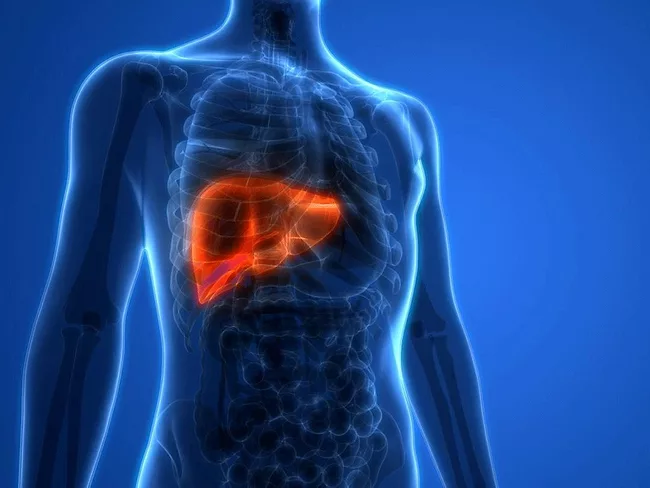
Organoids grown from cholangiocytes – the epithelial cells of the bile duct – are poised to be used in ex vivo cell therapy to increase the number of donated livers that are suitable for transplant, and also for direct bile duct repairs. The organoids have been shown to be effective in correcting defects in mouse models and in perfused donated livers. They are now being tested in large animal models.
Keeping you up to date on recent developments in cardiology, including: Algorithm can make echocardiography a breeze for the inexperienced; Algorithm suppresses CT scan time in chest imaging studies; Study shows distal radial access better for occlusion.
Keeping you up to date on recent developments in neurology, including: Deep brain stimulation prevents epileptic seizures in mouse model; Researchers discover promising biomarkers to diagnose mild TBI; New information on how antidepressants affect the brain uncovered.
Researchers at the University of California San Diego (UCSD) have taken wearables to a new level with a soft skin patch that integrates functions currently siloed in continuous glucose monitors, wearables, wellness apps and hospital monitors. The all-in-one patch can be worn on the neck to continuously track blood pressure, heart rate, glucose, lactate, alcohol and caffeine.
Keeping you up to date on recent developments in diagnostics, including: Urine offers early clues to cancer, Improving detection of esophageal cancer; PanFAM-1 study nears completion.
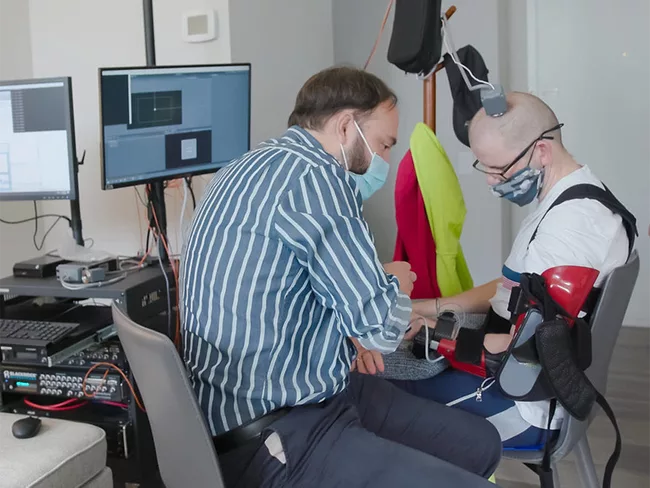
Researchers at Thomas Jefferson University have implanted brain electrodes in a patient who suffered a subcortical ischemic stroke more than a year ago to help them overcome abnormal muscle tone and control a robotic arm brace. Artificial intelligence (AI) algorithms interpret neuronal signals recorded by the electrodes into movement of the brace.
 RSS
RSS