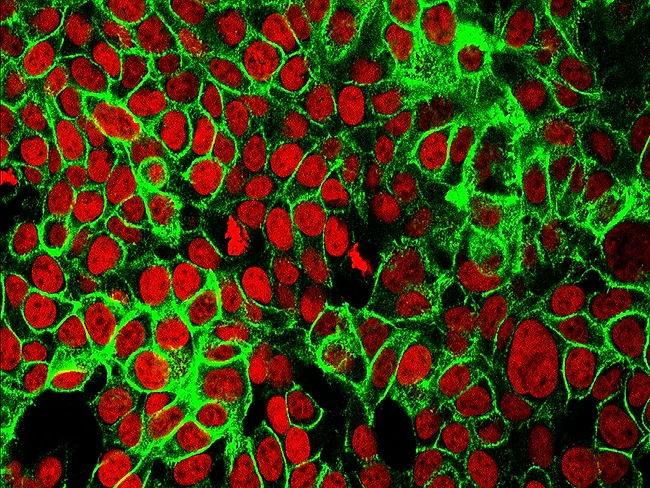
Despite wide availability and coverage for colonoscopy, many patients diagnosed with colorectal cancer (CRC) have never undergone the recommended screening procedure for the malignancy and its precursors. As a result, the cancer has already spread in the majority of cases at the time of diagnosis. CRC remains the third most common cancer diagnosed in the U.S. and the second leading cause of cancer death for both men and women.
Genexine Co. Ltd.’s DNA vaccine, GX-188E, showed potential in extending overall survival in patients with advanced cervical cancer in a phase II study when given in combination with Merck & Co. Inc.’s anti-PD-1 therapy, Keytruda (pembrolizumab). The Seoul, Korea-based company analyzed 60 patients with human papillomavirus (HPV)-16 or HPV-18-positive advanced cervical cancer who had progressed after standard-of-care therapy.
New and updated preclinical and clinical data presented by biopharma firms at the European Society for Medical Oncology Congress 2022, including: Adagene, Amgen, Ammax, Anaveon, Apexigen, Astellas, Astrazeneca, Ayala, Cardiff, Cel-Sci, Clovis, Daiichi, Deciphera, Eisai, Enlivex, Fore, Gritstone, GT, Ideaya, I-Mab, Imcheck, Immunogen, Merck & Co., Mereo, Neoimmunetech, Plus, Point, Regeneron, Shasqi, SQZ, Transgene, Wugen.
Researchers from Shaperon Inc. presented positive preclinical data for their clinical-stage candidate, sodium taurodeoxycholate (HY-209), demonstrating its therapeutic potential for atopic dermatitis.
The casual observer may be inclined to think that the European Union’s Medical Device Regulation (MDR) is off to a rocky start, but those whose livelihoods are at stake have a more intimate view of the situation. An attendee at a Sept. 12 session at this year’s Regulatory Convergence lamented what she believes is a dismal outlook for EU patients and device makers in the coming year, a testimonial that drew cheers and applause from those in attendance.
U.S. FDA commissioner Robert Califf resurrected a litany of complaints about medical product misinformation, including vaccinations for the COVID-19 pandemic, in a televised presentation heard by attendees at the Regulatory Affairs Professional Society (RAPS) annual conference here in Phoenix, where the daytime high temperatures are hovering at or near the century mark.
Some of the most exciting news out of the European Society for Medical Oncology Congress 2022 in Paris surrounded the rapidly evolving field of multi-cancer early detection (MCED), which offers the dual benefits of identifying malignancies at a more easily treated local stage and enabling screening for the 70% of cancers that lack recommended screening tests.
The gamma secretase inhibitor nirogacestat (Springworks Therapeutics Inc.) reduced the risk of disease progression by roughly 70% in a randomized placebo-controlled phase III trial in patients with desmoid tumors.
Data presented Sept. 9 at the European Society of Medical Oncology 2022 Congress showed impressive effects for KRAS inhibitors. But they also illustrated their limitations. Earlier-stage trials and researcher presentations, meanwhile, suggested ways those limitations might be addressed. Results from the Codebreak 200 study, presented in the day’s Presidential Symposium, were typical of the best that targeted therapies have to offer: large effects for brief time periods.