“The comment I hear a lot from scientists … is that science has no borders,” Arif Noorani, partner at Sidley Austin LLP, said while addressing the panel audience at Asia Bio 2025 in Singapore. “I agree, but the reality is, we do have a lot of borders.”
Although cagrilintide from Novo Nordisk A/S proved less than impressive when paired with GLP-1 agonist semaglutide in a single drug known as Cagrisema, the dual long-acting amylin analogue and calcitonin receptor agonist is looking good as a monotherapy in a subanalysis of the phase III Redefine-1 trial.
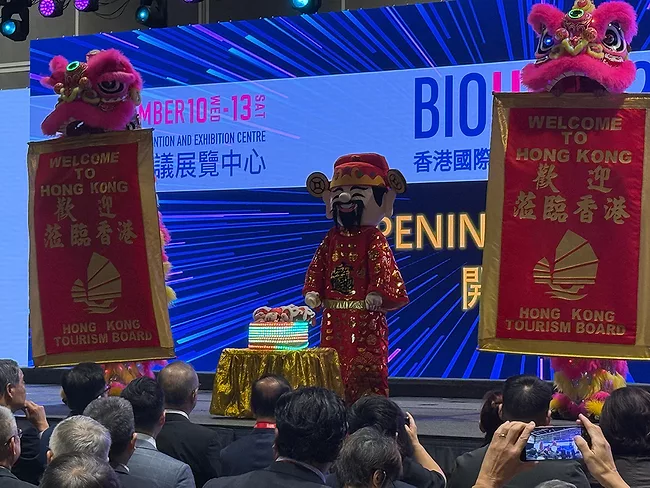
Artificial intelligence is no longer just a supporting tool in biotechnology – it is beginning to define the way drugs are discovered, tested and advanced into the clinic, speakers said during the Bio Hong Kong conference Sept. 10 to 13.
China was already making strides to lead the biotechnology industry in many key areas such as cell therapies and AI, but the chaotic nature of the Trump administration and the turmoil in the U.S. has catapulted China’s status as a more “dependable” partner, presenters said during the Bio Hong Kong conference, Sept. 10 to 13.
Iambic Therapeutics Inc. presented preclinical data on IAM-1363, a selective and irreversible HER2 and pan-HER2 mutant inhibitor in HER2-driven NSCLC models. In vitro studies across a panel of HER2-altered NSCLC cell lines demonstrated that IAM-1363 exhibits potent antiproliferative activity in both HER2-amplified and HER2-mutant models.
The Hong Kong biotech sector saw record growth this year, expanding 13%, fueled largely by investment in innovation ranging from CRISPR gene editing tools, cell therapies and artificial intelligence in drug discovery, speakers at the BIO Hong Kong conference said Sept. 10.
“The comment I hear a lot from scientists … is that science has no borders,” Arif Noorani, partner at Sidley Austin LLP, said while addressing the panel audience at Asia Bio 2025 in Singapore. “I agree, but the reality is, we do have a lot of borders.”
“New explosions in biotechnology are allowing us to interrogate cancers at a very sophisticated level compared to before,” Dennis Slamon told audience members at the Global Bio Conference in Seoul, South Korea Sept. 3.
Daiichi Sankyo Co. Ltd. and Merck & Co. Inc.’s antibody-drug conjugate (ADC) ifinatamab deruxtecan produced a confirmed 48.2% objective response rate in a phase II study of previously treated patients with extensive-stage small-cell lung cancer.
Positive phase I results in small-cell lung cancer (SCLC) from Ideaya Biosciences Inc. and partner Hengrui Pharmaceuticals Co. Ltd. with IDE-849, a potentially first-in-class antibody-drug conjugate targeting delta-like ligand 3 (DLL3) and topoisomerase 1, sharpened interest in the DLL3 mechanism, which gave Zai Lab Ltd. a phase Ia/Ib win this year in extensive-stage (ES) SCLC.
 RSS
RSS