Immunotherapy-based cancer vaccines could permanently kill tumors by stimulating immune cells in multiple ways. At the 27th Annual Meeting of the American Society of Gene & Cell Therapy (ASGCT), researchers presented their advances in this field with different techniques in the scientific symposium “Novel nucleic acid and cell-based vaccines for cancer,” organized by the infectious diseases and vaccines committee.
Immatics NV’s IMA-203 “looks like a melanoma drug,” said Cantor Fitzgerald analyst Eric Schmidt after he took a peek at the latest data, prepared as part of an upcoming meeting with the U.S. FDA. The candidate emerged from Immatics’ Actengine platform, set up to formulate a personalized therapy in which a patient’s own T cells are collected, genetically modified and then reinfused. Immatics offered data with IMA-203 as a monotherapy that targets preferentially expressed antigen in melanoma from an ongoing phase I trial testing what’s been established as the recommended phase II dose of 1-10x109 TCR-T cells in 30 heavily pretreated metastatic melanoma patients who were evaluable for efficacy.
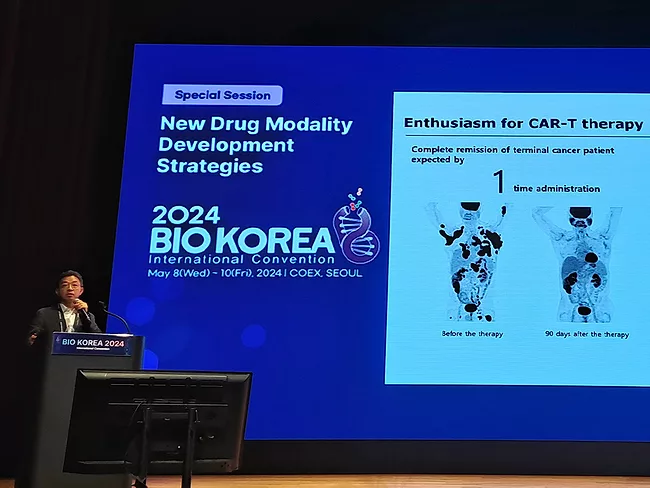
As South Korea’s Curocell Inc. looks to develop the country’s first homegrown CAR T-cell therapy, CEO Gunsoo Kim highlighted rising and falling trends in the global CAR T development space at Bio Korea 2024.
Citing a high rate of patients leaving the study, Merck & Co. Inc. has discontinued the anti-TIGIT antibody vibostolimab and the anti-PD-1 Keytruda (pembrolizumab) portion of it phase III Keyvibe-10 trial as an adjuvant treatment for those with resected high-risk melanoma.
Macrogenics Inc. CEO Scott Koenig said his firm is “on the right pathway” with vobramitamab duocarmazine (vobra duo), previously known as MGC-018, in metastatic castration-resistant prostate cancer. Wall Street proved less than thrilled, and shares of the Rockville, Md.-based firm (NASDAQ:MGNX) closed May 10 at $3.31, down $11.36, or 77%, after Macrogenics disclosed phase II results from the Tamarack study with vobra duo.
SN Bioscience Co. Ltd., headquartered in Seongnam-si, Gyeonggi-do’s second Pangyo Valley, gained U.S. FDA fast track designation for SNB-101 (SN-38), its new polymer nanoparticle cancer drug candidate for small-cell lung cancer.
Newco Commit Biologics ApS has arrived on the scene after raising €16 million (US$17.2 million) in a seed round to advance bispecific antibodies that are designed to activate the complement system and direct it to selectively kill cancer cells.
Intriguing data in pancreatic cancer didn’t do much to help shares of South San Francisco-based Cytomx Therapeutics Inc. (NASDAQ:CTMX), which closed May 9 at $2.04, down $2.15, or 51%, as the company made known initial findings from the ongoing CX-904 phase Ia dose-escalation study, showing a favorable safety profile and confirmed anticancer activity.
As the average cost of new drug R&D continues to skyrocket, the perception around using artificial intelligence (AI) as a tool to boost drug discovery is changing. “Developing new AI-based drugs is a difficult task, not only for Korea but also for countries with leading AI technology,” Hyeyun Jung, principal researcher of Korea Health Industry Development Institute’s Center for Health Industry Policy, told the audience at the Bio Korea meeting on May 9. “But there is a change in perception; [namely that] applying AI to new drug development is not an option but a necessity.”
India’s first indigenous CAR T therapy is expected to cost around $50,000, nearly one-tenth of the price of top-selling CAR Ts in the U.S. India President Droupadi Murmu officially launched Immunoadoptive Cell Therapy’s (Immunoact) NexCAR19 (actalycabtagene autoleucel), a CD19-targeted CAR T, and dedicated it to the nation in April 2024.
 RSS
RSS