GT Medical Technologies Inc. revealed that it has raised $16 million in a series B financing round led by MVM Partners, which was joined by existing investors Medtech Venture Partners and Bluestone Venture Partners. Funds will support the expanded commercialization of Gammatile Therapy, a surgically targeted radiation therapy (STaRT) that is intended to help patients with brain tumors.
Varian Medical Systems Inc. revealed that the first clinical trial of FLASH therapy has kicked off, with the initial treatment taking place at the Cincinnati Children's/UC Health Proton Therapy Center. The study, which saw the first patient treated this week, involves the investigational use of Varian's Probeam particle accelerator modified to enable radiation therapy delivery at ultra-high dose rates.
HONG KONG – Helio Health Inc. has new data that demonstrate the high accuracy and screening value of its cell-free DNA (cfDNA) methylation blood test for the detection of hepatocellular carcinoma (HCC).
The European Commission has awarded the CE mark to Hologic Inc. for its Genius Digital Diagnostics system for cervical cancer screening. According to the company, it is the first digital cytology platform to combine a new artificial intelligence (AI) algorithm with advanced digital imaging to assist cytotechnologists and pathologists in detecting precancerous lesions and malignant cells in women.
Boston Scientific Corp. reported that it has initiated the nationwide U.S. launch of Spaceoar Vue Hydrogel, a radiopaque version of Spaceoar Hydrogel that enables the use of computerized tomography scans instead of requiring magnetic resonance imaging (MRI) for patients undergoing radiation for prostate cancer.
Most of a pancreatic tumor is not made up of tumor cells – a double-edged sword for the tumor cells. This connective tissue component impedes blood flow, which is part of what makes pancreatic cancer so drug-resistant. But the lack of blood also means a lack of oxygen and nutrients, so pancreatic tumors must find alternate ways to feed themselves. That’s where nerves come in. In the Nov. 2, 2020, online issue of Cell, researchers published new insights into how innervation feeds tumors, and how to stop them from doing so.
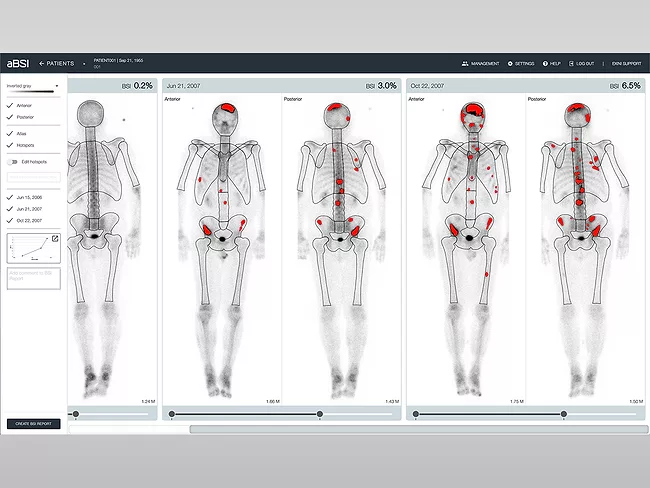
The U.S. FDA granted 510(k) clearance to Lantheus Holdings Inc.'s artificial intelligence (AI)-enhanced automated bone scan index (aBSI) product for prostate cancer on GE Healthcare's Xeleris platform. ABSI improves quantification and management of disease progression in advanced prostate cancer patients.
Novocure Ltd. has scored another win, this time gaining the CE mark for the NovoTTF-100L system. As a result, Novocure plans to commercialize the device as a first-line treatment in combination with pemetrexed and platinum-based chemotherapy for unresectable, locally advanced or metastatic, malignant pleural mesothelioma (MPM).
Varian Medical Systems Inc. has invested $10 million in and inked a collaboration agreement with Cota Inc., a Boston-based curator of oncology clinical data. The radiation oncology company will now offer its customers access to Cota’s oncology real-world analytics and data curation services, which aggregate electronic health record (EHR) data to yield meaningful insights.
LONDON – Clinical genomics specialist Congenica Ltd. has raised $50 million in a series C round that will enable it to extend beyond its roots in rare disease diagnosis to personalized medicine in cancer, and health and wellness, while expanding its geographical reach.
 RSS
RSS