Courage Therapeutics Inc. and University of Michigan have synthesized peptides acting as melanocortin MC4 receptor (MC4R) agonists and/or MC3 receptor (MC3R) antagonist/partial agonists reported to be useful for the treatment of arthritis, depression, diabetes, hypertension, renal disorders and sleep apnea.
A research team led by Domagoj Cikes at the Institute of Molecular Biotechnology of the Austrian Academy of Sciences (IMBA) and Josef Penninger at the University of British Columbia has discovered the critical role of the enzyme phosphate cytidylyltransferase 2 (PCYT2) in muscle health. Their findings appeared in the March 20, 2023, online edition of Nature Metabolism.
Shanghai Visonpharma Co. Ltd. has described Toll-like receptor 7 (TLR7) and/or TLR8 antagonists reported to be useful for the treatment of multiple sclerosis, lupus nephritis, psoriasis, rheumatoid arthritis, systemic scleroderma (systemic sclerosis), Sjogren syndrome and systemic lupus erythematosus.
Researchers from the University of Utah applied RNASeq analysis for an undiagnosed case of a critically ill newborn with a complex phenotype, with the aim of providing better diagnosis and improving treatment outcomes.
Gilead Sciences Inc. has exercised its option to exclusively license Nurix Therapeutics Inc.'s investigational targeted protein degrader molecule NX-0479, now designated GS-6791. This bivalent degrader is the first development candidate resulting from the companies' collaboration to discover, develop and commercialize up to five innovative targeted protein degradation therapies.
Systemic lupus erythematosus (SLE) is an autoimmune disease characterized by disrupted tolerance against nucleic acids, which form immune complexes with antibodies, finally leading to tissue damage. However, the mechanisms underlying the release of DNA from cells remain unexplained.
Osteoarthritis and its associated cartilage pathology affects 30 million people in the U.S., but no disease-modifying treatments have yet reached the clinic. A recent multicenter trial evaluating the safety and efficacy of a truncated, recombinant human fibroblast growth factor-18 (FGF18) protein analogue (rhFGF18) demonstrated a dose-dependent improvement in cartilage thickness relative to a placebo.
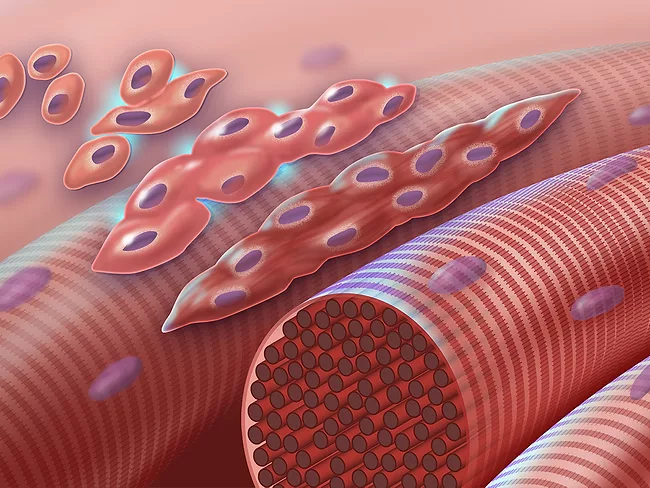
Researchers have linked Duchenne muscular dystrophy (DMD) to a loss of regenerative capacity of muscle stem cells. The findings, which were published in the March 1, 2023, issue of Science Translational Medicine, suggest that boosting the regenerative capacity of muscle stem cells could delay or perhaps even prevent the progression of DMD. DMD is “an early and horrible disease,” senior author Frederic Relaix, who is the director of a research team studying the biology of the neuromuscular system at the Mondor Institute for Biomedical Research told BioWorld.
Treatment with a cell-penetrating peptide that prevented nuclear export of unprocessed C9ORF72 RNA and its subsequent translation into neurotoxic dipeptide repeat proteins reduced motor neuron damage and death both in fruit fly models of amyotrophic lateral sclerosis (ALS), and in patient-derived induced neuronal precursor cells (iNPCs). The work suggests that targeting nuclear export could be a therapeutic option in ALS, and possibly also frontotemporal dementia (FTD), where C9ORF72 mutations also play a role.
Genascence Corp. has been awarded US$11.6 million over 4 years from the California Institute for Regenerative Medicine (CIRM) to help advance the company's GNSC-001 gene therapy for knee osteoarthritis (OA). The funding will support a phase Ib trial and manufacturing activities.

 RSS
RSS