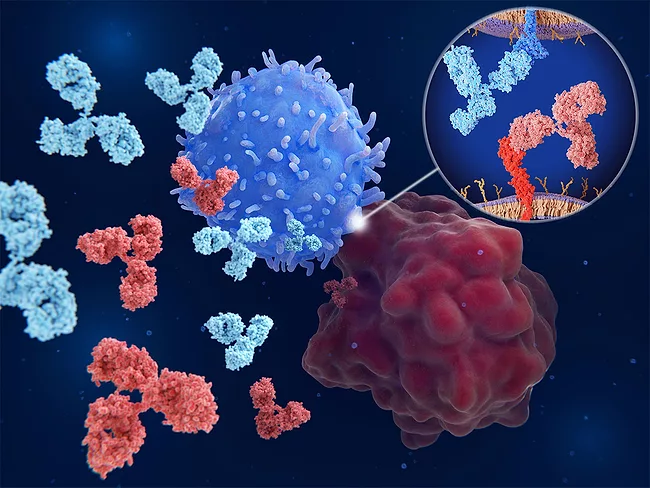
Despite the success of immunotherapy, it is still limited due to the poor control of which T cells are activated and how strong and how long they are activated. Next-generation T-cell activators should address this limitation by engagement of selective T-cell subsets, allowing stronger control and durable responses. Ipsen SA has presented data regarding their T-cell activator IPN-01203, which is bispecific and selective for Vβ6 and Vβ10 (Vβ6/10) TCR-expressing T cells, alongside with IL-15 receptor coactivation.
Researchers from Sanofi SA have detailed the development of a next-generation HER2-targeting T-cell engager (TCE) to increase selectivity for HER2-low tumor cells, while minimizing its effects on normal tissues expressing physiologic levels of HER2.
Although antibodies to PD-L1 are used in the clinic, their benefit is limited by immune exclusion within the local microenvironment. Objective response rates with anti-PD-L1 monotherapy are low due to the heterogeneity of PD-L1 expression, low tumor mutational burden and the highly immunosuppressive tumor microenvironment (TME) of cholangiocarcinoma (CCA).
Cisplatin is widely used in chemotherapy regimens for many solid tumors, yet its therapeutic benefit is counterbalanced by significant toxicity and immunologically related limitations. Researchers from Jiangxi University of Chinese Medicine described the preclinical efficacy of the PD-L1-targeted cisplatin prodrug MN42-81, designed to overcome these limitations.
CSPC Pharmaceutical Group Ltd.’s SYS-6051 has gained clinical trial clearance from China’s National Medical Products Administration (NMPA) for advanced solid tumors. SYS-6051 is a human tissue factor-targeted antibody-drug conjugate that binds to tissue factor expressed on the surface of tumor cells.
Mabwell (Shanghai) Bioscience Co. Ltd.’s has announced IND acceptance by China’s National Medical Products Administration (NMPA) for the company’s LILRB4/CD3 T-cell engager bispecific antibody 6MW5311. The drug candidate is being developed for hematologic malignancies, specifically acute myeloid leukemia (AML), chronic myelomonocytic leukemia and multiple myeloma.
Glyconex Inc. has received approval from Japan’s Pharmaceuticals and Medical Devices Agency (PMDA) for the initiation of a first-in-human phase I trial of GNX-1021, the company’s lead antibody-drug conjugate (ADC) candidate, in patients with advanced gastrointestinal (GI) cancers.
While most human papillomavirus (HPV) infections are cleared by the host immune system, persistent infection with high-risk HPV genotypes, particularly HPV16 and HPV18, can promote cervical cancer development. Researchers from Huazhong University of Science and Technology reported the development and preclinical characterization of KDTV-001, an HPV vaccine comprising a nonreplicating adenovirus type 5 vector encoding a codon-optimized fusion protein of the early antigens E6 and E7 derived from HPV genotypes 16, 18 and 52.
Researchers from Fudan University (Shanghai, China) and collaborators tested the use of senescent tumor cell (STC)-derived nanovesicles to enable spatiotemporally confined immune responses for selective clearance of radiotherapy-induced STCs.
Kazia Therapeutics Ltd. has licensed a first-in-class SETDB1-targeted epigenetic drug development platform from QIMR Berghofer. The company acquired global rights to the SETDB1 platform, including the lead candidate MSETC, in exchange for an up-front payment and a tiered revenue-sharing structure aligned with development progress.

 RSS
RSS