The U.K. Medicines and Healthcare products Agency (MHRA) has committed to major reforms of how it regulates drugs for rare diseases, making it easier to run clinical trials and get approvals. The new rules will be published in full early in 2026 and come into effect later in the year, but following consultation with industry, academics and patients’ groups, the agency has released a position paper setting out its plans.
Pfizer Inc. has delivered on its threat of legal action against the attempt by Novo Nordisk A/S to scupper its acquisition of Metsera Inc., and has filed two lawsuits, one alleging breach of contract, and a second claiming that a merger of Novo Nordisk and Metsera would violate antitrust regulations.
Uniqure NV is regrouping after a surprise switcheroo by the havoc-beset U.S. FDA regarding phase I/II studies with AMT-130 vs. external control in Huntington’s disease (HD) – news of which pushed down the Lexington, Mass.-based firm’s shares (NASDAQ:QURE) Nov. 3 by $33.40, a loss of 49%, at the closing price of $34.29.
Neurodegeneration specialist Vesper Bio ApS has announced positive results from the phase Ib/II trial of its oral sortilin inhibitor VES-001 in frontotemporal dementia. The small study involved six participants who had not progressed to symptomatic disease but were carriers of mutations in the GRN gene that codes for progranulin, a growth factor that is essential for neuronal health.
Pfizer Inc. is threatening legal action at an attempt by Novo Nordisk A/S to scupper its acquisition of Metsera Inc., with an unsolicited $9 billion offer for the anti-obesity specialist. That trumps Pfizer’s agreed bid made in September, which valued New York-based Metsera at $7.3 billion.
Qyuns Therapeutics Co. Ltd. signed a potential $1.07 billion license deal with Roche Holding AG, granting the latter exclusive rights to QX-031N – a human thymic stromal lymphopoietin and interleukin-33)-targeting bispecific antibody.
Sovargen Co. Ltd. inked a $550 million license deal with Angelini Pharma SpA, granting Angelini development and commercialization rights to SVG-105, a novel antisense oligonucleotide drug candidate in preclinical development as a potential treatment for intractable epilepsy.
An examination of X-ray and MRI scans of 518 patients before and after treatment with Levicept Ltd.’s Levi-04 has shown that, in addition to providing significant analgesia, the selective neurotrophin-3 inhibitor may have a disease-modifying effect in osteoarthritis of the knee.
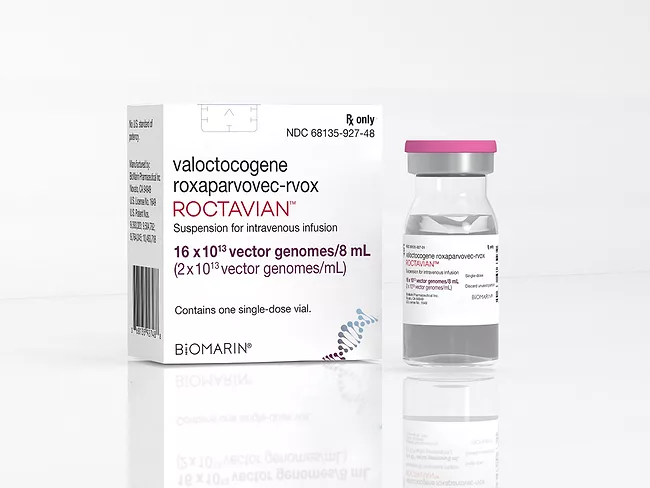
Biomarin Pharmaceutical Inc. plans to divest its pioneering gene therapy for hemophilia, Roctavian (valoctocogene roxaparvovec), and remove what had been considered a potential blockbuster from the portfolio in order to grow the company.
U.K. biotech companies raised 46% less in the third quarter (Q3) of 2025 than in the previous quarter, at £187 million (US$249.3 million). The Q3 2025 figure was also in the shade compared to Q1 2025, when biotechs raised £881 million, and 73% less than in Q3 2024.
 RSS
RSS