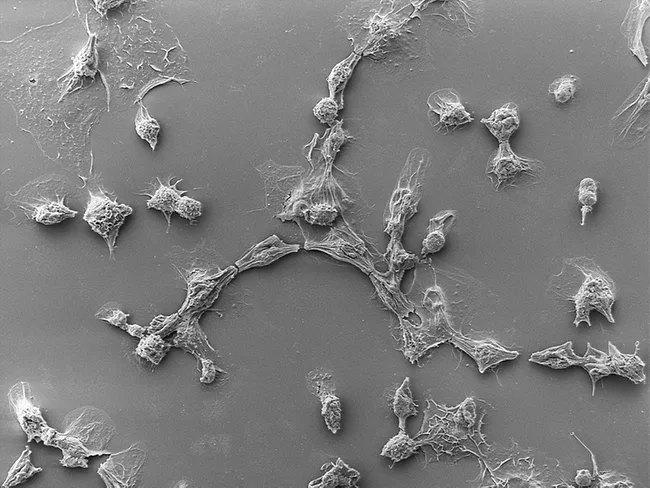
A research team based at MIT and Harvard has engineered a bacterial injection system to precisely deliver proteins to human cells. This work, published online March 29, 2023, in Nature, is important as while more and more molecular therapies are being developed, off-target effects are always a concern and precise targeting of cells and tissues can still be a challenge.
U.S. FDA commissioner Robert Califf went to Capitol Hill ostensibly to answer questions about the agency’s budget request for fiscal 2024, but the conversation quickly focused on issues such as baby formula and food supply security.
The U.S. FDA granted Graymatters Health Ltd. 510(k) clearance to market Prism for PTSD, a non-invasive, self-neuromodulation adjunct digital therapy for post-traumatic stress disorder (PTSD).
Aural Analytics Inc. received a breakthrough device designation from the U.S. FDA for its Speech Vitals-ALS technology, a software application that collects and analyzes speech recordings to help monitor amyotrophic lateral sclerosis (ALS) in adults in clinic and home settings. The software could improve management of the devastating disease.
The controversy over U.S. Medicare coverage of breakthrough devices is far from over as an administrative matter, but the House of Representatives is prepared to statutorily force the issue with a new bill that enjoys bipartisan support. The Ensuring Patient Access to Critical Breakthrough Products Act of 2023 provides instant Medicare coverage upon FDA clearance or approval of the device, a feature of previous policy proposals that the CMS has found administratively problematic.
U.S. lawmakers have been busy writing to government agencies demanding answers and explanations on a range of issues, including drug shortages, gain-of-function research and thickets of duplicative patents that extend patent protection well beyond 20 years for some prescription drugs.
The U.S. FDA gave Bot Image Inc. a coveted threefer with 510(k) clearance for its Prostatid artificial intelligence (AI) software for detection, diagnosis and monitoring of prostate cancer using both standard MRI and a non-invasive bi-parametric MRI, which does not require a contrast agent.
The Biden administration’s budget proposal for the U.S. federal government’s 2024 fiscal year is undergoing the usual vetting in Congress, and one hearing each in the House and Senate suggest the proposal will gain little or no traction on Capitol Hill. However, supporters of the National Institutes of Health (NIH) may be cheered by the fact that one of President Biden’s own party, Rep. Rosa DeLauro (D-Conn.), blasted the proposal for offering only a 2% increase in the NIH budget, a sign that the agency will receive a substantial boost in monies yet again in FY 2024.
Illumina Inc. released Connected Insights in a beta version for the U.S., following its commercial release in other selected countries. Connected Insights, an assay-agnostic, cloud-based software designed to streamline interpretation and reporting across next-generation sequencing (NGS) types, was initially developed for somatic oncology applications, the system will shortly also support whole genome sequencing for rare diseases.
Preparing for next month’s launch of the first U.S. FDA-approved therapy for activated phosphoinositide 3-kinase delta syndrome (APDS), a rare disease only identified 10 years ago, Pharming Group NV disclosed pricing for the newly branded Joenja (leniolisib) of $750 per tablet, or $547,500 per year.

 RSS
RSS