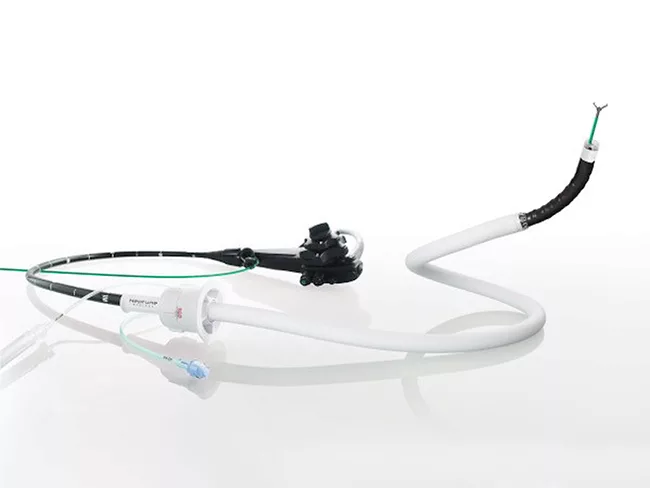
Multiple sizes of Neptune Medical LLC’s overtube for gastrointestinal (GI) procedures that allows thin-walled tubes to toggle between flexible and rigid states received FDA clearance. With the clearance, the Burlingame, Calif.-based company now has nine sizes of cleared single-use overtubes with more in the wings. The Pathfinder endoscope overtube device uses Neptune’s Dynamic Rigidization technology to keep tubes from looping during procedures, a problem that leads to procedure failure, patient pain and complications in colonoscopy and other GI procedures.
The U.S. National Institutes of Health had its hands full with the Rapid Acceleration of Diagnostics (RADx) program as the COVID-19 pandemic unwound, but the agency’s other work on diagnostics is bearing fruit. NIH said Aug. 31 that its collaboration with an academic research institute has led to development of a test that predicts which patients suffering from neurofibromatosis will develop cancers with metastatic potential.
In studies that give new insights into both developmental biology and the origins of melanoma, investigators at Memorial Sloan-Kettering Cancer Center and Weill Cornell Medical College have identified the activity of chromatin remodeling protein ATAD2 as necessary for cells with the oncogenic mutation V600E to give rise to melanomas. Involvement of epigenetic factors in cancers, or their targeting, is not new in cancer – as HDAC inhibitors as well as newer drugs such as the EZH2 inhibitor Tazverik (tazemetostat, Epizyme Inc.) demonstrate. But to Richard White and his colleagues, the point of their work is not so much about individual targets.
Abbott Laboratories, has acquired Walk Vascular LLC, a deal that brings two devices for peripheral thrombectomy to the Abbott portfolio for peripheral artery disease (PAD). Walk’s two Jeti peripheral thrombectomy devices are cleared in the U.S. for break-up and removal of soft emboli and thrombus, but are in trial for deep-vein thrombosis (DVT) as well, suggesting that Abbott Park, Ill.-based Abbott has availed itself of a technology that could take a big bite out of one of the deadliest and costliest of all circulatory system pathologies.
Even as the Biden administration pushes for drug imports from Canada as a way to help curb U.S. prescription drug prices, Canada is doubling down on its efforts to protect its supply of drugs and medical devices.
In a precedential opinion, the U.S. Court of Appeals for the Federal Circuit affirmed a lower court’s conclusion that Belcher Pharmaceuticals LLC’s chief science officer engaged in inequitable conduct by withholding material information from the U.S. Patent and Trademark Office during prosecution of Belcher’s 9,283,197 patent.
Now that the U.S. judge overseeing Purdue Pharma LP’s bankruptcy proceedings has conditionally signed off on a $10 billion settlement intended to resolve 3,000 opioid lawsuits filed by states, tribes and local governments, the privately owned drugmaker can take the first steps to transform itself into a public service company owned mostly by the National Opioid Abatement Trust and governed by a new independent board.
Onkos Surgical Inc. nabbed an additional $15 million from its existing investors in a series C fundraising round. The Parsippany, N.J.-based company plans to use the new cash to accelerate research and development for its product line which is designed to meet the specialized needs of oncology patients who require orthopedic surgery and the surgeons who work with them.
The Medical Device Innovation Consortium (MDIC) has launched a digital health initiative that will aid the FDA in its efforts to devise a workable regulatory system for these products, which includes a work stream for change control. This work stream promises to be a massive effort, but Joe Sapiente, MDIC's vice president for clinical science and technology, told BioWorld that MDIC needs subject matter experts in this and several other areas to sustain the group’s momentum and thus aid the FDA’s efforts to produce guidance for digital health products.
U.S. Attorney General (AG) Merrick Garland has rescinded two important policy documents, including the Brand memo, which limited the ability of federal prosecutors to use non-compliance with federal agency guidance as proof of violations of the law. The rescission of these memos increases the risk that drug and device companies will be prosecuted more vigorously due to deviation from FDA guidance documents, which at times conflict with other guidances and thus may create a series of nearly unavoidable compliance failures.
 RSS
RSS