BioWorld. Link to homepage.

Clarivate
  • BioWorld
  • BioWorld Science
  • BioWorld Asia
  • Data Snapshots
    • Biopharma
    • Medical technology
    • Infographics: Dynamic digital data analysis
    • Index insights
    • NME Digest
  • Special reports
    • Infographics: Dynamic digital data analysis
    • BCI
    • Ebola outbreak
    • Hantavirus
    • Trump administration impacts
    • Med-tech outlook 2026
    • Under threat: mRNA vaccine research
    • BioWorld at 35
    • Biopharma M&A scorecard
    • Bioworld 2025 review
    • BioWorld MedTech 2025 review
    • BioWorld Science 2025 review
    • Women's health
    • China's GLP-1 landscape
    • PFA re-energizes afib market
    • China CAR T
    • Alzheimer's disease
    • Coronavirus
    • More reports can be found here

BioWorld. Link to homepage.

  • Sign In
  • Sign Out
  • My Account
Subscribe
BioWorld - Saturday, June 27, 2026
Home » Topics » Genetic/congenital, BioWorld Science

Genetic/congenital, BioWorld Science
Genetic/congenital, BioWorld Science RSS Feed RSS

Skeletal system
Genetic/congenital

TYRA-300 shows efficacy in hypochondroplasia model

July 3, 2024
Hypochondroplasia (HCH) is a skeletal dysplasia similar to achondroplasia (ACH) but with milder features, that affects particularly the ossification of proximal long bones of arms and legs. Around 70% to 80% of cases of HCH are caused by N540K alterations in the FGFR3 gene. At the recent 6th Annual Achondroplasia & Skeletal Dysplasia Research Conference, researchers from Tyra Biosciences Inc. presented preclinical proof-of-concept data of TYRA-300, an oral FGFR3-selective inhibitor in a model of HCH.
Read More
Bridge recombinase mechanism 3D illustration
Drug design, drug delivery & technologies

New techniques open the way for large-scale programmable genome editing

June 26, 2024
By Mar de Miguel
New single-step genome editing techniques that enable the insertion, inversion or deletion of long DNA sequences at specified genome positions have been demonstrated in bacteria. The advance opens the door to the development of programmable methods for rearranging DNA, using recombinase enzymes guided by RNA. The two different approaches to using insertion sequences (IS) – some of the simplest and most compact mobile genetic elements – are described in two papers published in Nature and Nature Communications.
Read More
Illustration of DNA strand next to lungs
Respiratory

In vivo mRNA editing of cystic fibrosis mutations in mice

June 25, 2024
Scientists at Recode Therapeutics Inc. have developed an optimized lipid nanoparticle (LNP) to act on specific tissues.
Read More
Brain as light bulb filament
Genetic/congenital

Novel human MEDopathy caused by biallelic MED16 variants

June 13, 2024
Variants in several subunits of the Mediator protein complex are responsible for MEDopathies, which present variable clinical manifestations and modes of inheritance. Researchers from Université de Paris Cité have investigated the role of MED16, a subunit of the evolutionary-conserved Mediator complex, in MEDopathies.
Read More
A DNA double helix rests on a print-out illustration of the DNA  base pair letters A, T, C and G.
Biomarkers

New causative gene for Perrault syndrome identified

June 7, 2024
At the ESHG meeting in Berlin, a novel causative gene for Perrault syndrome was presented by a researcher from the University of Manchester. Perrault syndrome is a rare autosomal recessive disease characterized by sensorineural hearing loss and primary ovarian insufficiency.
Read More
Cancer

Relay Therapeutics discloses new genetic disease and oncology programs

June 6, 2024
Relay Therapeutics Inc. has disclosed three new programs from its existing preclinical pipeline, including two novel programs from its genetic disease portfolio and a potentially first-in-class NRAS-selective inhibitor.
Read More
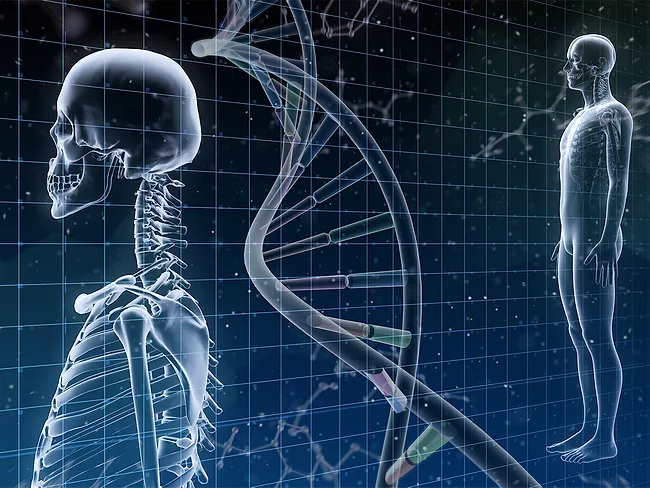
Human body skeleton with DNA science background art
Musculoskeletal

Blueprint’s work behind drug for fibrodysplasia ossificans progressiva

June 5, 2024
By Xavier Bofill Bruna
Fibrodysplasia ossificans progressiva is a rare and life-threatening genetic disease caused by gain-of-function mutations in the ALK2 gene, which encodes activin receptor-like kinase 2. Blueprint Medicines Corp. has elucidated the discovery of their ALK2 inhibitor BLU-782, which is now in phase II studies at Ipsen for the treatment of FOP.
Read More
Eye and DNA
Biomarkers

NDUFA7 identified as new disease gene in Leber’s hereditary optic neuropathy

June 5, 2024
Researchers from Landeskrankenhaus Salzburg (SALK) - Universitätsklinikum der PMU have identified a novel loss-of-function variant in the NDUFA7 gene in a patient with Leber’s hereditary optic neuropathy (LHON).
Read More
Two silhouettes with tangle, gear, spiral
Neurology/psychiatric

Dissecting post-traumatic stress disorder and depression

May 28, 2024
By Mar de Miguel
Scientists from the PsychENCODE Consortium have analyzed the brain transcriptome in a coordinated series of studies to map all the cell types, genes, epigenetic factors, and molecular pathways involved in different psychiatric disorders. After a first set of projects based on bulk analysis, the second phase of this project included 14 simultaneous publications that revealed the cellular atlas of post-traumatic stress disorder (PTSD) and major depressive disorder (MDD), among others.
Read More
Genetic/congenital

AAV9-CTNNB1 gene therapy restores β-catenin expression and function in CTNNB1 syndrome

May 23, 2024
CTNNB1 syndrome is a rare neurodevelopmental disorder that is caused by mutations in the gene encoding β-catenin, CTNNB1, which plays a critical role in neuronal development, synapse formation and brain maturation.
Read More
Previous 1 2 … 20 21 22 23 24 25 26 27 28 … 39 40 Next

Popular Stories

  • Today's news in brief

    BioWorld
    BioWorld briefs for June 26, 2026.
  • Blue brain with computer chip

    Have brain-computer interfaces finally arrived?

    BioWorld
    More and more individuals now have chronically implanted brain-computer interface (BCI) systems in their heads. Devices that can record and stimulate neural...
  • News in brief

    BioWorld Asia
    BioWorld Asia briefs for June 23, 2026
  • Cortec Brain Interchange BCI system

    Brain-computer interfaces are here but long road ahead

    BioWorld
    The field of BCI is continually evolving; as such, companies are increasingly highlighting the potential of their technologies to transform care. For advanced...
  • Patient using Neuracle NEO system

    2026 marks critical turning point for BCI technology

    BioWorld
    Decades of research are helping unravel the “black box” of the brain. The second article in BioWorld’s series on the Brain-Computer Interface (BCI) field looks at...
  • BioWorld
    • Today's news
    • Analysis and data insight
    • Clinical
    • Data Snapshots
    • Deals and M&A
    • Financings
    • Medical technology
    • Newco news
    • Opinion
    • Regulatory
  • BioWorld Science
    • Today's news
    • Biomarkers
    • Cancer
    • Conferences
    • Endocrine/metabolic
    • Immune
    • Infection
    • Neurology/psychiatric
    • NME Digest
    • Patents
  • BioWorld Asia
    • Today's news
    • Analysis and data insight
    • Australia
    • China
    • Clinical
    • Deals and M&A
    • Financings
    • Newco news
    • Regulatory
    • Science
  • More
    • About
    • Advertise with BioWorld
    • Archives
    • Article reprints and permissions
    • Contact us
    • Cookie policy
    • Copyright notice
    • Data methodology
    • Infographics: Dynamic digital data analysis
    • Index insights
    • Podcasts
    • Privacy policy
    • Share your news with BioWorld
    • Staff
    • Terms of use
    • Topic alerts
Follow Us

Copyright ©2026. All Rights Reserved. Design, CMS, Hosting & Web Development :: ePublishing