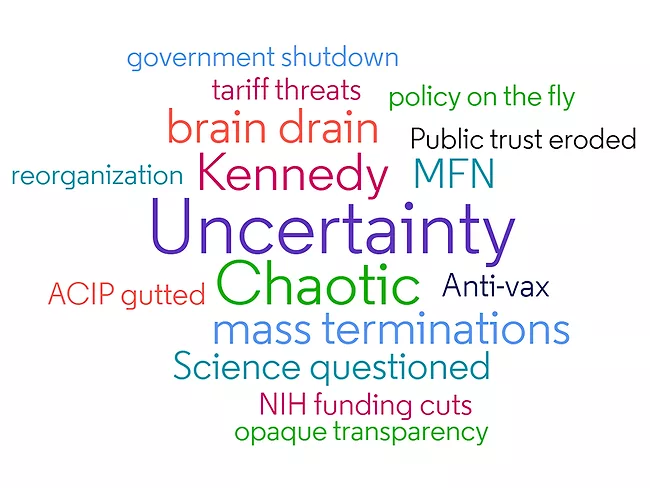
If the 2025 U.S. life sciences regulatory scene were to be summed up in one word, it would have to be uncertainty. Two words might be more definitive – chaotic uncertainty.
After an all-night negotiating session that concluded after 5 am on Dec. 12, political agreement was finally reached on the long-awaited EU pharmaceutical legislation. The aim of the new rules is to improve patient access and increase the competitiveness of the sector, but for the industry, it was too little too late in terms of the incentives, and potentially damaging in the measures to improve access.
In a threshold event in the U.S., Medicare is planning to break through its obesity coverage barrier with a voluntary test of a model designed to enable Medicare Part D plans and state Medicaid programs to cover GLP-1 drugs prescribed for weight management.
Driven by a deeply antiscientific political agenda, the current U.S. government is not just sabotaging some of the most groundbreaking technology that has been developed in the past decades. It is also destroying the country’s past successes, such as measles elimination and the reduction of hepatitis B infections in infants to near zero.
Then there were three. With the administration’s Dec. 19 announcement of most-favored-nation (MFN) pricing deals with nine more biopharmas, only three of the 17 companies on the receiving end of U.S. President Donald Trump’s July 31 MFN ultimatum have yet to finalize terms with the White House – Abbvie Inc., Johnson & Johnson (J&J) and Regeneron Pharmaceuticals Inc.
In 2025, science saw its breakthroughs, which BioWorld will be covering as part of our end-of-the-year wrap-up. But the biggest science story of 2025 is not about any scientific advance. It is the politicized destruction of U.S. science, and the dismantling of a scientific ecosystem that has been the envy of the world since it emerged after Germany destroyed its own pre-eminence in the 1930s.
The Trump administration has made known that it intends to foster rapid adoption of AI, starting with a repeal of an executive order (EO) issued by the Biden administration. Now, the White House has issued an EO that would override state AI law, a move that addresses a task that Congress to date has failed to complete.
A group of eight Democratic senators is asking biopharma companies to spill the beans about their private most-favored-nation pricing deals with U.S. President Donald Trump. Led by Sen. Ron Wyden, D-Ore., ranking member of the Senate Finance Committee, the senators sent letters Dec. 11 to Astrazeneca plc, Eli Lilly and Co., Novo Nordisk A/S and Pfizer Inc. seeking the details of those deals. While it’s difficult to discern how the deals will benefit patients, it’s clear the companies stand to gain a lot from the agreements, the letter asserted.
As the systematic dismantling of the U.S. vaccine schedule escalates, the demands to hold Health and Human Services Secretary Robert Kennedy accountable are growing. Claiming that Kennedy has turned his back on science and is endangering public health, Rep. Haley Stevens, D-Mich., formally introduced articles of impeachment against him Dec. 10 for “high crimes and misdemeanors.” Under the Constitution, federal officials can only be impeached for treason, bribery and “other high crimes and misdemeanors.”
Individual liberty and choice vs. wider public health became one predictable hinge upon which swung the often-acerbic debates at the CDC’s Advisory Committee for Immunization Practices (ACIP) meeting, which took up – again – the matter of hepatitis B virus (HBV) vaccine scheduling, a day after the panel voted not to vote on such guidance.
 RSS
RSS