Israeli startup Olive Diagnostics Pvt. Ltd. is aiming to disrupt at-home urinalysis testing with a hands-free, noninvasive, artificial intelligence (AI)-based solution that provides remote diagnostics by detecting urine’s molecular composition. K2, as the device is called, attaches easily to the toilet rim to generate secure, personalized diagnostic data that directly links to a mobile app.
PERTH, Australia – After its initial public offering on the Australian Securities Exchange, soft tissue regeneration company Aroa Biosurgery Ltd. has received new clearances in the U.S. and Europe and is focusing on building up its commercial and manufacturing capacity.
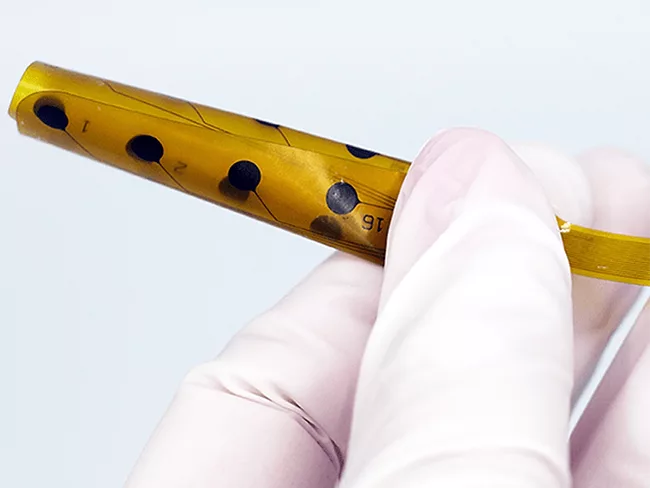
Neuroone Medical Technology Corp.’s thin film, high definition cortical electrode technology, Evo, can record, monitor, ablate, and stimulate brain tissue for up to 30 days, potentially transforming neurosurgical procedures used to treat epilepsy, Parkinson’s disease, chronic pain, and other conditions.
PERTH, Australia – With 1 in 3 patients with type 2 diabetes likely to develop diabetic kidney disease (DKD), Perth-based Proteomics International Laboratories Ltd. has developed a blood-based diagnostic test that can predict the onset of DKD, enabling patients to get treatment sooner to prevent the onset of the disease.
Clearcam Inc.'s Kelling device has an improved view of the market thanks to the closing of a $2.6 million series 2 seed financing round, led by investor and entrepreneur Frank Barbella, CEO of Solv Risk Solutions.
CAPS Medical, of Netanya, Israel, closed a $3.5 million series A round led by Chasing Value Asset Management and the Los Angeles-based Israel Investment Fund Group. The new funds will be used to enable CAPS to undertake its first clinical trial for its minimally invasive, nonthermal plasma device for cancer treatment and further develop its portfolio for the treatment of solid tumors.
PERTH, Australia – Startup Inventia Life Science Pty. Ltd. has received two major investments from the Australian government to accelerate the development of a robotic device that prints a patient’s own skin cells directly onto a burn or wound. Named Ligō from the Latin “to bind,” the device could revolutionize the way surgeons approach wound repair.
By deleting the gene for uridine monophosphate synthetase (UMPS), an enzyme in the pathway for uridine synthesis, researchers have made cells, including embryonic stem cells and T cells, dependent on dietary uridine. The work, which was published in the July 13, 2020, online issue of Nature Biotechnology, adds a new potential way of controlling cell therapies.
Endpoint Health Inc. has made its official debut, scooping up $12 million in debt and equity financing from a host of investors, including Mayfield, Y Combinator, Ame Cloud Ventures and Wireframe Ventures. The Palo Alto, Calif.-based company is focused on helping people with illnesses such as sepsis and acute respiratory distress syndrome (ARDS) – life-threatening conditions often caused by serious infections, including COVID-19.
Mastor SAS secured €3 million (US$3.39 million) in seed investment from Sofinnova Partners' MD Start III Fund and €1.9 million in non-dilutive funding through the i-Nov Innovation Award from BPI France, the French national public investment bank.
 RSS
RSS