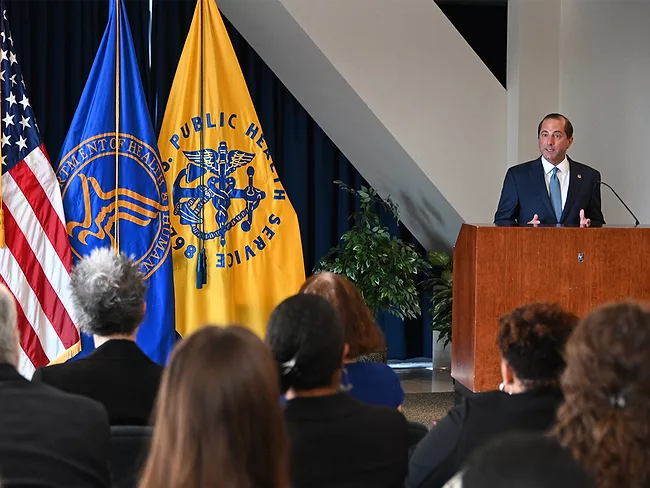
Now that U.S. Health and Human Services (HHS) Secretary Alex Azar has declared a nationwide public health emergency due to the 2019 novel coronavirus (2019-nCoV), HHS is saying it may need more money to help it be as proactive and aggressive as possible in detecting the virus and containing an outbreak.
The U.S. Department of Health and Human Services has declared a public health emergency in the U.S. over the coronavirus in part because a government diagnostic for the virus yields inconsistent results, a fact that may spur the life sciences to provide a solution.
LONDON – Brexit finally becomes a reality at midnight central European time on Jan. 31, but for the life sciences industry uncertainty continues, as the U.K. enters an 11-month transition phase during which the terms of its future relationship with the EU must be negotiated.
The World Health Organization (WHO) has declared a "public health emergency of international concern" over the global outbreak of novel coronavirus (2019-nCoV), reversing a week-ago decision by its International Health Regulations Emergency Committee. The move comes "not because of what is happening in China, but because of what is happening in other countries," said WHO Director General Tedros Adhanom Ghebreyesus, noting his confidence in China’s capacity to control the outbreak. "Our greatest concern is the potential for the virus to spread to countries with weaker health systems, and which are ill-prepared to deal with it," he said.
LONDON – It has gone from “pneumonia of unknown cause” affecting 44 patients in Wuhan, China, on Jan. 5, 2020, to spark a global health alert, with the World Health Organization (WHO) now looking likely to declare the outbreak of the novel coronavirus, 2019-nCoV, a public health emergency of international concern (PHEIC) less than four weeks later.
Despite pressure from several lawmakers to declare the new coronavirus a U.S. public health emergency, Health and Human Services (HHS) Secretary Alex Azar said such a declaration isn’t needed, at least not yet.
The U.S. Centers for Medicare and Medicaid Services (CMS) has significantly relaxed the national restrictions on coverage of next-generation sequencing for cancer, affirming that early-stage breast and ovarian cancer patients will be covered. However, Medicare administrative contractors can cover tests that have not been reviewed by the FDA, a move that should also significantly boost utilization for makers of next-generation sequencing systems in clinical labs.
SANTA CLARA, Calif. – Diabetes seems likely to be the first area to really show concrete products and results for the ambitious Verily Life Sciences, which is the med-tech business of Mountain View, Calif.-based Google parent Alphabet Inc. However, its two major diabetes partners both have been rethinking the relationship.
Whether large or small, or based in the U.S. or abroad, life sciences companies are an increasingly attractive target for shareholder suits. The number of securities fraud class action suits filed in the U.S. in 2019 across all industries totaled 404, just one more than the 403 cases filed in 2018 and down from the peak of 412 in 2017, according to a new Dechert LLP report.
SANTA CLARA, Calif. – Just as it does with treatments, the National Comprehensive Cancer Network (NCCN) offers detailed guidelines on genomic testing by cancer type. These are key in determining what physicians can prescribe routinely and what insurers will cover. But those guidelines aren’t followed regularly outside a major research hospital setting, thereby obviating access to tumor genetic information that could help to better guide treatment. Even if current guidelines are followed, physicians and patients can get information back from the tests that neither party is prepared to process.

 RSS
RSS