The drug screens prompted by the SARS and MERS outbreaks have been useful for quickly identifying drug candidates. But in terms of their epidemiology, “SARS and MERS were different from this coronavirus,” Allison McGeer explained at a Feb. 3 webinar by Evercore ISI.
Touting the efforts his administration already has taken to lower U.S. prescription drug prices through increased competition, President Donald Trump placed the burden for further action squarely on Congress during his State of the Union address Tuesday, Feb. 4.
At this very early point in the emerging 2019-nCoV outbreak, knowledge about the virus is insufficient to predict what shape that outbreak will ultimately take. But knowledge about the virus is accumulating at remarkable speed, and experience with other viruses is helping to shape the response to the newest coronavirus threat. 2019-nCoV, sometimes called Wuhan coronavirus after its source, is the third coronavirus after SARS-CoV and MERS-CoV with the potential to cause serious illness and death that has emerged since the beginning of the 21st century.
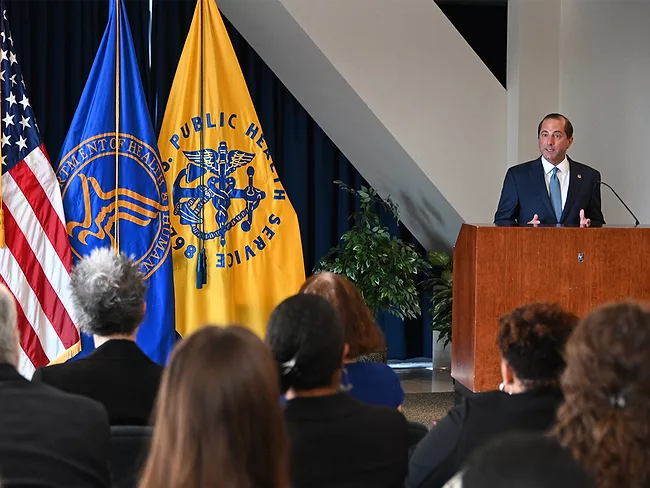
Now that U.S. Health and Human Services (HHS) Secretary Alex Azar has declared a nationwide public health emergency due to the 2019 novel coronavirus (2019-nCoV), HHS is saying it may need more money to help it be as proactive and aggressive as possible in detecting the virus and containing an outbreak.
The U.S. Department of Health and Human Services has declared a public health emergency in the U.S. over the coronavirus in part because a government diagnostic for the virus yields inconsistent results, a fact that may spur the life sciences to provide a solution.
LONDON – Brexit finally becomes a reality at midnight central European time on Jan. 31, but for the life sciences industry uncertainty continues, as the U.K. enters an 11-month transition phase during which the terms of its future relationship with the EU must be negotiated.
The World Health Organization (WHO) has declared a "public health emergency of international concern" over the global outbreak of novel coronavirus (2019-nCoV), reversing a week-ago decision by its International Health Regulations Emergency Committee. The move comes "not because of what is happening in China, but because of what is happening in other countries," said WHO Director General Tedros Adhanom Ghebreyesus, noting his confidence in China’s capacity to control the outbreak. "Our greatest concern is the potential for the virus to spread to countries with weaker health systems, and which are ill-prepared to deal with it," he said.
LONDON – It has gone from “pneumonia of unknown cause” affecting 44 patients in Wuhan, China, on Jan. 5, 2020, to spark a global health alert, with the World Health Organization (WHO) now looking likely to declare the outbreak of the novel coronavirus, 2019-nCoV, a public health emergency of international concern (PHEIC) less than four weeks later.
Despite pressure from several lawmakers to declare the new coronavirus a U.S. public health emergency, Health and Human Services (HHS) Secretary Alex Azar said such a declaration isn’t needed, at least not yet.
The U.S. Centers for Medicare and Medicaid Services (CMS) has significantly relaxed the national restrictions on coverage of next-generation sequencing for cancer, affirming that early-stage breast and ovarian cancer patients will be covered. However, Medicare administrative contractors can cover tests that have not been reviewed by the FDA, a move that should also significantly boost utilization for makers of next-generation sequencing systems in clinical labs.
 RSS
RSS