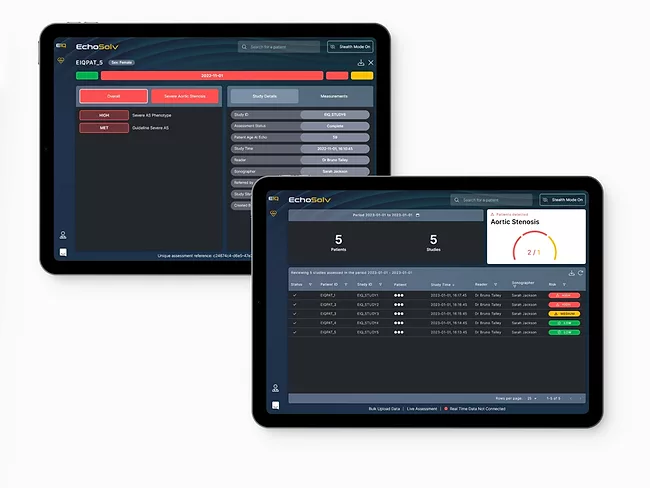
The U.S. FDA gave the 510(k) green light to Echo IQ Ltd.’s Echosolv AS for its AI-enabled software as a medical device to be used as a decision support aid in detecting severe aortic stenosis.
Med-tech happenings, including deals and partnerships, grants, preclinical data and other news in brief: Aditxt, Amwell, Apogepha, Avania, Baird Medical, Biolase, Evofem, Hello Heart, J&J, Jointvue, Nanovibronix, Smith+Nephew, Sonendo, V-Wave.
David Baker, Demis Hassabis and John Jumper share the 2024 Nobel Prize in Chemistry for their contributions to the science of protein structure. David Baker was awarded half the prize “for computational protein design,” according to the Royal Swedish Academy of Sciences. Hassabis and Jumper shared the other half “for protein structure prediction.”
David Baker, Demis Hassabis and John Jumper share the 2024 Nobel Prize in Chemistry for their contributions to the science of protein structure. David Baker was awarded half the prize “for computational protein design,” according to the Royal Swedish Academy of Sciences. Hassabis and Jumper shared the other half “for protein structure prediction.”
It’s hard to know where to start in describing the biopharma applications of the 2024 Nobel Prize in Physics. It was awarded to John Hopfield and Geoffrey Hinton “for foundational discoveries and inventions that enable machine learning with artificial neural networks.”
GE Healthcare Technologies Inc. is participating in the €25.3 million (US$27.8 million) Thera4care project that aims to expand the use of theranostics in Europe. The 29 partners involved in the project will develop new cancer treatment tools, strengthen the manufacture and supply of radiotheranostic, and optimize the clinical use of radiotheranostics.
 RSS
RSS