BioWorld. Link to homepage.

Clarivate
  • BioWorld
  • BioWorld MedTech
  • BioWorld Asia
  • BioWorld Science
  • Data Snapshots
    • BioWorld
    • BioWorld MedTech
    • Infographics: Dynamic digital data analysis
    • Index insights
    • NME Digest
  • Special reports
    • Infographics: Dynamic digital data analysis
    • Trump administration impacts
    • Under threat: mRNA vaccine research
    • BioWorld at 35
    • Biopharma M&A scorecard
    • Bioworld 2025 review
    • BioWorld MedTech 2025 review
    • BioWorld Science 2025 review
    • Women's health
    • China's GLP-1 landscape
    • PFA re-energizes afib market
    • China CAR T
    • Alzheimer's disease
    • Coronavirus
    • More reports can be found here

BioWorld. Link to homepage.

  • Sign In
  • Sign Out
  • My Account
Subscribe
BioWorld - Sunday, February 1, 2026
Breaking News: BioWorld 2025 Year in ReviewBreaking News: Trump administration impacts continue to roil the life sciences sector
Home » Topics » BioWorld Asia, Science

BioWorld Asia, Science
BioWorld Asia, Science RSS Feed RSS

Colorful illustration of the heart
Cardiovascular

Human iPSCs restore muscle, function in monkeys with heart failure

May 7, 2024
By Tamra Sami
Japanese researchers have transplanted human induced pluripotent stem cells (iPSCs) in a primate model of myocardial infarction and were able to restore heart muscle and function in monkeys. Developed by Tokyo-based Heartseed Inc., the grafted iPSCs consist of clusters of purified heart muscle cells (cardiomyocyte spheroids) that are injected into the myocardial layer of the heart. Published in Circulation on April 26, 2024, the study showed that the cardiomyocyte spheroids survived long term and showed improved contractile function with low occurrence of post-transplant arrhythmias.
Read More
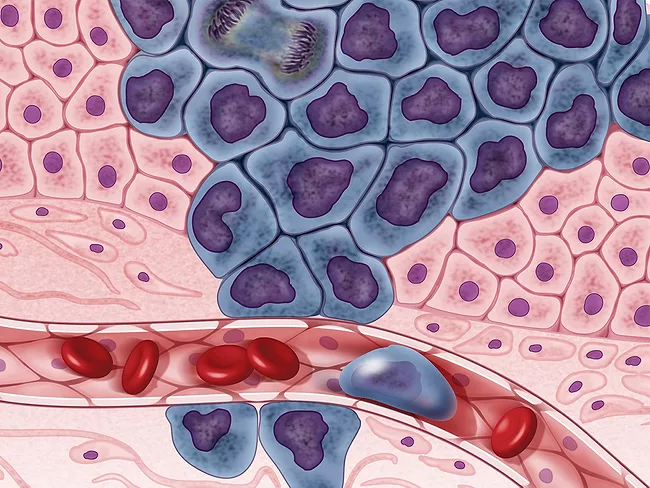
Illustration of cancer cells entering the bloodstream.
Cancer

AACR 2024: New concepts suggest new targets for metastatic disease

April 16, 2024
By Anette Breindl
Prior to this year’s Annual Meeting of the American Association for Cancer Research (AACR), it had been 14 years since metastasis had been the subject of a plenary session. So, the Tuesday session on “Evolution of the genome, microenvironment, and host through metastasis” had plenty of new insights to share.
Read More
DNA mutations or genetic disorder concept art
Dermatologic

Australian researchers discover gene mutation that causes psoriasis

April 2, 2024
By Tamra Sami
Scientists from the Australian National University have discovered the gene mutation responsible for causing psoriasis, and the findings could lead to improved diagnosis and treatment for patients with psoriasis and psoriatic arthritis, a chronic inflammatory skin disease. “We were able to identify the gene that could be important in enabling this progression from a skin-only condition to a skin-and-joint condition,” lead study author Chelisa Cardinez told BioWorld.
Read More
Virus particles attacking neuron
HIV/AIDS

CROI 2024: HIV is active in the CNS despite ART

March 5, 2024
By Mar de Miguel
On March 4, 2024, several groups of scientists discussed the challenges of investigating the effects of HIV in the central nervous system (CNS) at the oral abstract session on neuropathogenesis of HIV held during the 31st Conference on Retroviruses and Opportunistic Infections (CROI), in Denver. A cure for HIV will require eliminating the virus in all its reservoirs, those tissues where HIV remains latent but retains the capacity for reactivation and replication. However, despite antiretroviral therapy (ART), the virus could continue to replicate continuously at a low level in some reservoirs, including the CNS.
Read More
Illustration of COVID-19 virus cells affecting brain
Infection

Proteomic signature can identify long COVID

Jan. 23, 2024
By Anette Breindl
Researchers at ETH Zurich have identified a proteomic signature that could recognize long COVID six months after acute infection. Biologically, the signature indicated that the complement system remained active in patients with long COVID six months after infection. Translationally, it could lead to a diagnostic test for long COVID, and suggests that targeting the complement system could be a therapeutic approach to prevent or treat the disorder.

Read More
Art concept for ancient DNA
Genetic/Congenital

MS? Blame great-great-great-great-great-great-great-great-grandma

Jan. 16, 2024
By Mar de Miguel
Current risk genes for some diseases such as multiple sclerosis (MS) may have emerged in the past as protection against infection by different pathogens. A group of researchers led by scientists from the University of Copenhagen has analyzed the ancient DNA of European populations and has revealed how MS, Alzheimer’s disease (AD) and diabetes arose as populations migrated. This evolution would explain the modern genetic diversity and the incidences of these pathologies observed today in the old continent.
Read More
Art concept for pangenome wrapping around the globe

In 2023, big projects create ‘satellite maps’ of cell biology

Jan. 9, 2024
By Mar de Miguel
If we unraveled the DNA of the 46 chromosomes of a single human cell, it would barely measure 2 meters. If we did the same with the rest of the body, if we aligned the 3 billion base pairs of its 5 trillion cells, we could travel the distance from the Earth to the Sun more than 100 times. It seems unreachable. However, that is the unit of knowledge of the large sequencing projects achieved in 2023.
Read More
Images showing the green fluorescence signals in different body parts of the live-birth chimeric monkey.
Drug Design, Drug Delivery & Technologies

1st chimeric monkey born with large embryonic stem cell contribution

Nov. 14, 2023
By Anette Breindl
Investigators at the Chinese Academy of Sciences have generated a chimeric monkey by injecting an embryonic stem cell into the morula, which is an extremely early embryo consisting of 16 to 32 cells. The animal survived for only 10 days, and it is not the first live birth of a chimeric primate. But it is the first such chimera with contributions from an embryonic stem cell, and that stem cell contributed a far higher proportion of cells in the newborn than have been achieved in previous attempts at creating chimeras.
Read More
AI generated illustration of lungs in the human body
Cancer

ESMO 2023: New approaches to old targets, including HER2 and p53

Oct. 24, 2023
By Mar de Miguel
Some cancers with a poor prognosis have had no new treatments in decades. Advances in the genetic characterization of these tumors now offer a range of possibilities for the development of new therapies that could completely change the quality of life and survival of these patients.
Read More
Nobel Prize graphic with illustrations of Moungi Bawendi, Louis Brus and Alexei Ekimov
Drug Design, Drug Delivery & Technologies

Nobel Prize in Chemistry 2023 goes to quantum dots, which illuminated the path to nanotechnology

Oct. 4, 2023
By Mar de Miguel
Quantum dots, a phenomenon in quantum physics that alters the energy of electrons and changes the properties of particles, caught the attention of the Royal Swedish Academy of Sciences (KVA) for the 2023 Nobel Prize in Chemistry.
Read More
Previous 1 2 3 4 5 6 7 8 9 … 13 14 Next

Popular Stories

  • Today's news in brief

    BioWorld
    BioWorld briefs for Jan 30, 2025.
  • Today's news in brief

    Briefs
    BioWorld MedTech briefs for Jan. 30, 2026.
  • Brain with stroke illustration

    Brain-derived tau in blood predicts stroke severity and outcome

    BioWorld Science

    Brain-derived tau, a protein that is exclusive to the brain and detectable in the blood, could serve as an indicator of brain damage after an ischemic stroke. The...

  • Centessa’s CNT-9982 shows promise for MDD

    BioWorld Science
    Orexin OX2 receptor agonists have demonstrated the ability to enhance wakefulness in rodent models, as well as in nonhuman primates and patients with narcolepsy...
  • Red and blue bispecific antibodies

    First-in-class ADC targeting DEM-TXX shows high preclinical efficacy

    BioWorld Science
    Researchers at DEM Biopharma Inc. reported preclinical findings demonstrating the efficacy of DEM-301, a bifunctional antibody-drug conjugate (ADC) engineered to...
  • BioWorld
    • Today's news
    • Analysis and data insight
    • Clinical
    • Data Snapshots
    • Deals and M&A
    • Financings
    • Newco news
    • Opinion
    • Regulatory
    • Science
  • BioWorld MedTech
    • Today's news
    • Clinical
    • Data Snapshots
    • Deals and M&A
    • Financings
    • Newco news
    • Opinion
    • Regulatory
    • Science
  • BioWorld Asia
    • Today's news
    • Analysis and data insight
    • Australia
    • China
    • Clinical
    • Deals and M&A
    • Financings
    • Newco news
    • Regulatory
    • Science
  • BioWorld Science
    • Today's news
    • Biomarkers
    • Cancer
    • Conferences
    • Endocrine/Metabolic
    • Immune
    • Infection
    • Neurology/Psychiatric
    • NME Digest
    • Patents
  • More
    • About
    • Advertise with BioWorld
    • Archives
    • Article reprints and permissions
    • Contact us
    • Cookie policy
    • Copyright notice
    • Data methodology
    • Infographics: Dynamic digital data analysis
    • Index insights
    • Podcasts
    • Privacy policy
    • Share your news with BioWorld
    • Staff
    • Terms of use
    • Topic alerts
Follow Us

Copyright ©2026. All Rights Reserved. Design, CMS, Hosting & Web Development :: ePublishing