The next-generation farnesyl transferase inhibitor KO-2806 is currently in phase I clinical development at Kura Oncology Inc. for the treatment of patients with solid tumors, including non-small-cell lung cancer (NSCLC) and colorectal cancer (CRC).
Mirati Therapeutics Inc.’s cancer treatment Krazati (adagrasib) is having a tough time outside the U.S. The EMA’s Committee for Medicinal Products for Human Use (CHMP) came out with a negative opinion on an MAA for treating KRAS G12C-mutated advanced non-small-cell lung cancer (NSCLC). The ruling came with a flurry of positive CHMP opinions for companies, including Abbvie Inc., Beigene Ltd. and the Janssen Pharmaceutical Cos., plus a mixed result for Ipsen SA after a stumble earlier this week.
As largely expected, Mirati Therapeutics Inc.’s adagrasib gained U.S. FDA accelerated approval ahead of its Dec. 14 PDUFA date, cleared for second-line use in patients with non-small-cell lung cancer (NSCLC) harboring the KRAS G12C mutation, in which it will go up ahead Amgen Inc.’s Lumakras (sotorasib), which has the advantage of a year and a half head start.
The pandemic has forced pharma and biotech to be more agile to better navigate the obstacles and still find success. Supply chain gaps are part of the problem, as are clinical trial delays. Yet the industry has successfully forged ahead in the past year to produce the seven drugs Clarivate believes in the next five years will each earn more than $1 billion annually.
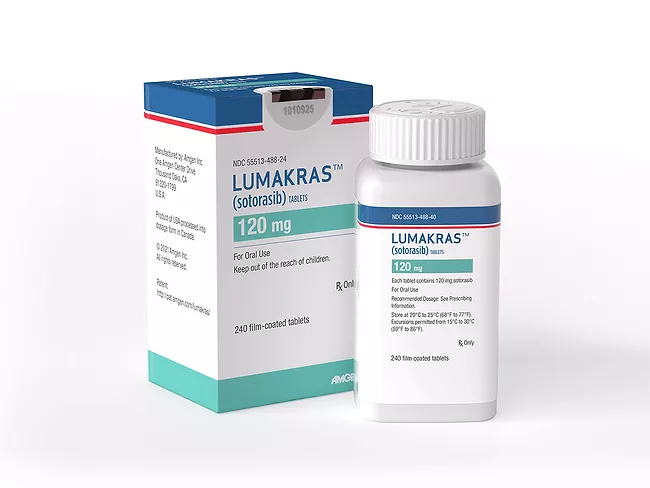
Amgen Inc.’s Merdo Gordon, head of commercial global operations, said just-approved Lumakras (sotorasib) is “priced very well compared to other targeted medicines available in the market” for cancers driven by specific mutations. “Just characterizing the launch broadly, look, it’s really hard to tell because of the variability of our reach to customers right now” – a result of the COVID-19 pandemic.
KRAS is the most frequently mutated oncogene in solid tumors in general, and in lung tumors in particular. There are more patients whose lung tumors are driven by KRAS mutations than by ALK, Ros, Ret and TRK alterations. Combined. And after 40 years, they look to be getting a targeted therapy, or even two.
KRAS is the most frequently mutated oncogene in solid tumors in general, and in lung tumors in particular. There are more patients whose lung tumors are driven by KRAS mutations than by ALK, Ros, Ret and TRK alterations. Combined. And after 40 years, they look to be getting a targeted therapy, or even two.
KRAS is the most frequently mutated oncogene in solid tumors in general, and in lung tumors in particular. There are more patients whose lung tumors are driven by KRAS mutations than by ALK, Ros, Ret and TRK alterations. Combined. And after 40 years, they look to be getting a targeted therapy, or even two.
The 2020 World Conference on Lung Cancer, which was scheduled to take place in Singapore last August, is set to kick off virtually later this week. The postponement gave companies time to generate additional data as they battle to treat patients with their targeted therapies.
Mirati Therapeutics Inc.’s update on the phase I/II Krystal trial of the KRAS-G12C-targeting adagrasib (MRTX-849) was arguably the most eagerly awaited news, and certainly the most eagerly awaited KRAS-targeting news, to come out of the 2020 EORTC-NCI-AACR (ENA) Molecular Targets meeting. KRAS is one of the most frequently mutated oncogenes across a wide swath of solid tumors, and has been one of the toughest nuts to crack as far as druggability is concerned.