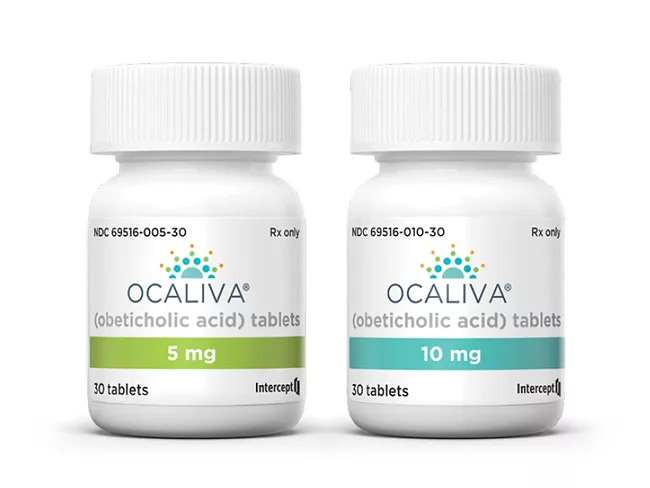
When it won U.S. FDA accelerated approval more than eight years ago, Intercept Pharmaceuticals Inc.’s Ocaliva (obeticholic acid) was viewed as a breakthrough, becoming the first new treatment in 20 years for rare, progressive liver disease primary biliary cholangitis (PBC) and, for several years, the only second-line treatment for PBC patients failing to respond to ursodeoxycholic acid. More recently, however, Ocaliva has faced regulatory and safety stumbles, with Intercept now voluntarily pulling the farnesoid X receptor activator from the U.S. market.
The EMA’s Committee for Medicinal Products for Human Use recommended 17 drugs for approval at its December meeting, bringing the total for 2024 to 114. That is up from the 77 drugs recommended for approval in 2023, of which 39 were novel.
The conditional marketing approval for Ocaliva (obeticholic acid) has been revoked with immediate effect, following a standoff between the EMA and Advanz Pharma Ltd., the company that markets the primary biliary cholangitis (PBC) therapy in Europe. On Sept. 5, London-based Advanz won a short reprieve after challenging the EMA’s June 28 ruling that the marketing authorization for Ocaliva should be revoked, when the General Court of the EU granted a temporary suspension of EMA’s decision. However, on Nov. 27, Advanz announced the court had said it would not be extending the suspension.
Intercept Pharmaceuticals Inc. lost its uphill battle to convince the U.S. FDA’s Gastrointestinal Drugs Advisory Committee that the risks of its second-line primary biliary cholangitis drug outweigh the benefits. The committee overwhelmingly said the data in the follow-up studies of treating the rare disease with Ocaliva (obeticholic acid), which has accelerated approval from the FDA, was insufficient.
Friday the 13th could be a make-or-break day in the U.S. for Intercept Pharmaceuticals Inc.’s Ocaliva (obeticholic acid). That’s the day the company will make its case before the FDA’s Gastrointestinal Drugs Advisory Committee for turning an 8-year-old accelerated approval into traditional approval.
Advanz Pharma Ltd. has won a stay on the withdrawal of its primary biliary cholangitis (PBC) drug, Ocaliva (obeticholic acid), after the European Commission (EC) said on Sept. 3 that the conditional marketing approval should be revoked. Following that, London-based Advanz launched a legal challenge, announcing on Sept 5 that the General Court of the EU has temporarily suspended the EC’s decision. As a result, the conditional marketing authorization for Ocaliva remains in place until further notice from the court, and the 7,000 existing patients – and new ones – will still have access to the farnesoid X receptor agonist.
Label comparisons began promptly with the accelerated U.S. FDA clearance of Gilead Sciences Inc.’s oral peroxisome proliferator-activated receptor (PPAR)-delta drug, Livdelzi (seladelpar), for primary biliary cholangitis (PBC). The space includes Ipsen Pharma SA’s dual PPAR alpha/delta agonist, Iqirvo (elafibranor), licensed from Genfit SA and cleared in June 2024, as well as Ocaliva (obeticholic acid), the first-in-class farnesoid X receptor agonist from Intercept Pharmaceuticals Inc., greenlighted for PBC in May 2016.
The EMA’s Committee for Medicinal Products for Human Use (CHMP) recommended approval of 14 drugs and the extension of the label of 11 others at its July meeting, but, inevitably, it was the decision to turn down the Alzheimer’s disease therapy Leqembi (lecanemab) that stirred the greatest reaction.
Ipsen SA, of Paris, struck a $461 million deal with Day One Biopharmaceuticals Inc. for ex-U.S. rights to tovorafenib, an oral drug for pediatric brain tumor that gained U.S. FDA accelerated approval April 23 as Ojemda (tovorafenib).
Those affected by primary biliary cholangitis (PBC) are fighting back against the recommendation by the EMA that the marketing authorization for Ocaliva (obeticholic acid), a second-line treatment used by 7,000 patients in Europe, be withdrawn. Earlier today, July 25, patients and their supporters staged a protest outside the European Commission building in Brussels to oppose EMA’s position that Ocaliva’s conditional license should be revoked.