The notion that advances in artificial intelligence (AI) are a question of national economic competitiveness has been gaining currency of late, and a hearing in the U.S. House of Representatives lent more credence to the idea. Jordan Crenshaw of the U.S. Chamber of Commerce referred to the hazard of allowing dictatorships to set the standard for the use of AI as well as the ever-increasing global economic impact of these algorithms, adding that when it comes to AI, the U.S. is “in a race we must win” for both ethical and economic reasons.
Following on a trifecta of regulatory wins, Optellum Ltd. raised $14 million in a series A funding round to commercialize its artificial intelligence (AI)-enabled lung cancer diagnostic platform. Optellum’s Virtual Nodule Clinic, which helps physicians identify and monitor patients at-risk of lung cancer, has received U.S. FDA clearance, CE-MDR in the European Union and UKCA in the U.K.
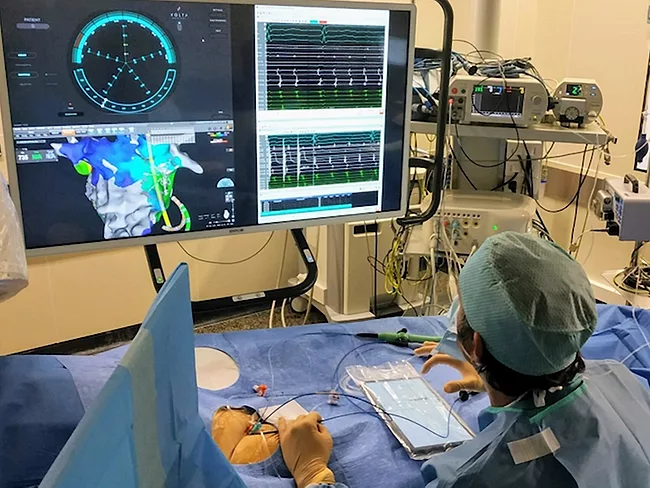
Volta Medical SAS reported validation for its VX1 software mapping system, an artificial intelligence (AI) algorithm compatible with most commonly available multi-pole catheters and technology used in operating rooms and cath labs for treating cardiac arrhythmia. Results from the proof-of-concept-study were published in the Journal of Cardiovascular Electrophysiology.
The U.S. NIH is not generally regarded as a wellspring of concepts and policies in the world of artificial intelligence (AI), but that perception may change soon thanks to the agency’s Bridge2AI program. The agency announced recently that it will drop $130 million into this program over four years in an effort to develop standards for data used in AI research, a key development for device makers seeking to sell products that use these complex algorithms.
The U.S. NIH is not generally regarded as a wellspring of concepts and policies in the world of artificial intelligence (AI), but that perception may change soon thanks to the agency’s Bridge2AI program. The agency announced recently that it will drop $130 million into this program over four years in an effort to develop standards for data used in AI research, a key development for device makers seeking to sell products that use these complex algorithms.
Genomics is moving out of the research lab to become a routine element of health care, particularly in oncology to detect gene variants that indicate a patient will respond to a targeted cancer drug, and in the diagnosis of rare diseases.
For the one in eight couples struggling to conceive, the improvements in infertility treatments achieved by employment of artificial intelligence (AI) in diagnostics, personalized therapies and embryo selection may soon mean the difference between childlessness and the family of their dreams.
The University of Sydney is investing AU$478 million (US$326.5 million) to build a leading biomedical precinct to fast-track research and shorten the time between discovery and development of transformative therapies.
Startup Curimeta Inc. emerged from stealth with $6 million in seed financing led by Washington University School of Medicine in St. Louis and BJC Healthcare, a St. Louis-based nonprofit health care system. Cultivation Capital Healthcare Innovation Fund also participated in the round.