In reporting positive data from a phase III study of sugemalimab in treating stage III non-small-cell lung cancer (NSCLC), Cstone Pharmaceuticals Co. Ltd. and Eqrx Inc. have the first anti-PD-L1 monoclonal antibody demonstrating progression-free survival in patients with concurrent or sequential chemoradiotherapy. The data built on positive data released in August from another phase III study showing sugemalimab (CS-1001) prolonged PFS when used as a first-line treatment for stage IV squamous and nonsquamous NSCLC plus standard-of-care chemotherapy, hitting the study’s primary endpoint.
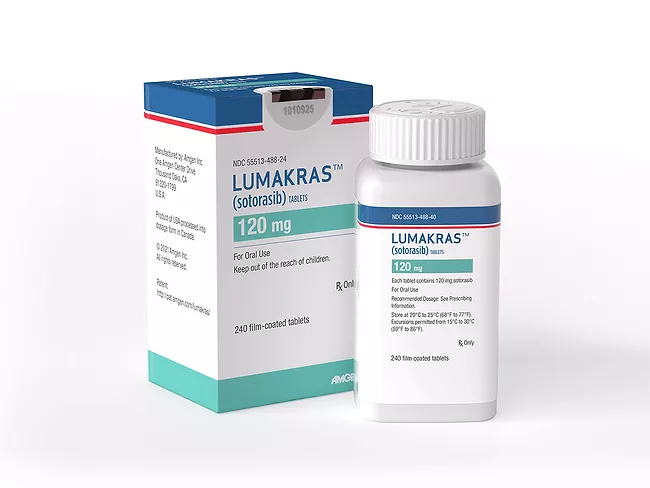
Amgen Inc.’s Merdo Gordon, head of commercial global operations, said just-approved Lumakras (sotorasib) is “priced very well compared to other targeted medicines available in the market” for cancers driven by specific mutations. “Just characterizing the launch broadly, look, it’s really hard to tell because of the variability of our reach to customers right now” – a result of the COVID-19 pandemic.
Well ahead of the assigned Aug. 16 PDUFA date, Amgen Inc. bagged accelerated clearance from the FDA for Lumakras (sotorasib), the first targeted therapy for adults with KRAS G12C-mutated locally advanced or metastatic non-small-cell lung cancer (NSCLC), as determined by an FDA-approved test.
Locust Walk Acquisition Corp. CEO and biotech veteran Chris Ehrlich said his firm sifted through more than 90 prospects before setting on a merger with Effector Therapeutics Inc., focused on selective translation regulation inhibitors (STRIs) in cancer.
The FDA’s approval for Johnson & Johnson (J&J) of Rybrevant (amivantamab-vmjw) not only brings the first treatment for adults with non-small-cell lung cancer (NSCLC) whose tumors bear EGFR exon 20 insertion mutations, but also sets a high overall response rate bar for other developers in the space.
Suzhou-China based Cstone Pharmaceuticals Co. Ltd., which in-licensed RET inhibitor pralsetinib from Blueprint Medicines Corp. in 2018, has won Chinese approval for the drug to treat adult patients with locally advanced or metastatic RET fusion-positive non-small-cell lung cancer after platinum-based chemotherapy. Already approved as Gavreto in the U.S., the drug is Cstone’s first product approved in China and the country’s first selective RET inhibitor.
Suzhou-China based Cstone Pharmaceuticals Co. Ltd., which in-licensed RET inhibitor pralsetinib from Blueprint Medicines Corp. in 2018, has won Chinese approval for the drug to treat adult patients with locally advanced or metastatic RET fusion-positive non-small-cell lung cancer after platinum-based chemotherapy. Already approved as Gavreto in the U.S., the drug is Cstone’s first product approved in China and the country’s first selective RET inhibitor.
New interim phase II data in advanced non-small-cell lung cancer (NSCLC) has shown that a combination of Heat Biologics Inc.'s cell therapy candidate, HS-110 (viagenpumatucel-L), and Bristol Myers Squibb Co.'s Opdivo (nivolumab) helped extend overall survival for both checkpoint inhibitor-naïve patients and those who had been treated with a checkpoint inhibitor but whose disease had later progressed.
Mckesson Corp. has brought together several oncology organizations, life sciences companies, and patient advocacy groups to increase understanding of non-small-cell lung cancer (NSCLC) and leverage targeted therapies to improve outcomes. The Molecularly Informed Lung Cancer Treatment in a Community Cancer Network: A Pragmatic Consortium (MYLUNG) study will observe and analyze 12,000 community-based, metastatic NSCLC patients to learn more about barriers to molecular testing for targeted therapies, how those therapies are being used, and to expand opportunities for participation in clinical trials.
Just weeks after seeing one late-stage candidate hit a wall in a subtype of non-small-cell lung cancer (NSCLC), Merck KGaA's EMD Serono has won accelerated approval from the FDA for another important NSCLC therapy, Tepmetko (tepotinib).