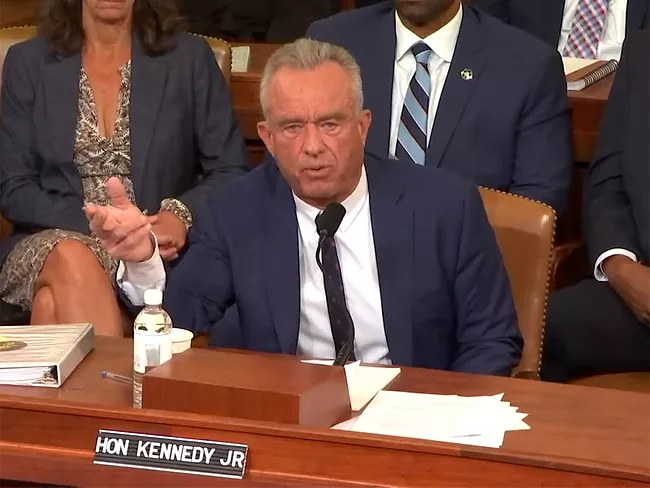
U.S. Health and Human Services (HHS) Secretary Robert Kennedy made his first stop April 16 on a congressional tour in support of President Donald Trump’s proposed fiscal 2027 budget, which would reduce discretional spending for HHS and its agencies by about 12%.
In one fell swoop March 16, a U.S. federal judge stayed the CDC’s January memo revising the childhood vaccine schedule and the Advisory Committee on Immunization Practices (ACIP) as reconstituted by Health and Human Services Secretary Robert Kennedy, along with everything that committee has done since early June.
Researchers from Model Medicines Inc. have presented preclinical efficacy data for MDL-001, a first-in-class, oral non-nucleoside inhibitor that targets an allosteric site in the Thumb-1 domain of the viral polymerase.
Gwangju Institute of Science & Technology, National Cancer Center of Korea and Seoul National University have jointly divulged new PreS1 (hepatitis B virus, HBV) derivatives for the treatment of HBV infection.
Reporting sales of its hepatitis B vaccine Heplisav-B pretty much in line with consensus and a phase I/II shingles prospect moving along, Dynavax Technologies Corp. scored a takeover deal with Sanofi SA, which is paying $15.50 per share in cash for a total equity value of about $2.2 billion. The amount is a 39% premium to Dynavax’s closing share price yesterday, Dec. 23.
Driven by a deeply antiscientific political agenda, the current U.S. government is not just sabotaging some of the most groundbreaking technology that has been developed in the past decades. It is also destroying the country’s past successes, such as measles elimination and the reduction of hepatitis B infections in infants to near zero.
BioWorld’s 2022 end-of-year highlights included a toast to the future – of universal vaccines. Even before SARS-CoV-2 vaccines were developed in record time and saved countless lives during the COVID-19 pandemic, vaccines were a rare bright spot in the fight against infectious diseases. Bacteria are becoming multidrug resistant far faster than new classes of antibiotics are being developed, viral spillover events and vector ranges are increasing, and climate change is helping bacteria and fungi alike breach human thermal protections against infections.
Chinese University of Hong Kong has identified peptides acting as serine/arginine-rich protein-specific kinase 1 (SRSF protein kinase 1; SRPK1) inhibitors reported to be useful for the treatment of lung cancer, breast cancer, coronavirus acute respiratory syndrome, hepatitis and herpes viral infections.
Nchroma Bio Inc. has received a certificate for clinical trial in Hong Kong to initiate a first-in-human phase I/II trial of CRMA-1001 for the treatment of chronic hepatitis B virus (HBV) infection. Dosing is expected to begin early next year.
As the systematic dismantling of the U.S. vaccine schedule escalates, the demands to hold Health and Human Services Secretary Robert Kennedy accountable are growing. Claiming that Kennedy has turned his back on science and is endangering public health, Rep. Haley Stevens, D-Mich., formally introduced articles of impeachment against him Dec. 10 for “high crimes and misdemeanors.” Under the Constitution, federal officials can only be impeached for treason, bribery and “other high crimes and misdemeanors.”