Novelmed Therapeutics Inc. has reported topline results with its lead anti-properdin antibody NM-3086 in a rabbit model of paroxysmal nocturnal hemoglobinuria (PNH). NM-3086 is a potent, first-in-class, humanized monoclonal antibody that is highly selective for properdin of the alternative pathway (AP) without blocking the classical pathway (CP), which is critical for maintaining host defense against infections.
A prespecified interim analysis revealed that Astrazeneca plc’s oral factor D inhibitor danicopan met the primary endpoint of a phase III trial as an add-on therapy for patients with paroxysmal nocturnal hemoglobinuria (PNH) who were also taking a C5 inhibitor, but who still experienced extravascular hemolysis.
Alexion Pharmaceuticals Inc. has demonstrated the commercial potential for rare disease drugs with its complement inhibitor Soliris (eculizumab) and long-lasting follow-up Ultomiris (ravulizumab) driving blockbuster sales. A host of other companies are hoping to compete with Ultomiris, which is U.S. FDA-approved for paroxysmal nocturnal hemoglobinuria and atypical hemolytic uremic syndrome.
Elevated serum creatinine levels in some participants prompted Biocryst Pharmaceuticals Inc. to pause three clinical trials involving BCX-9930, an oral, small-molecule factor D inhibitor for treating rare diseases.
LONDON – The EMA recommended approval of Apellis Pharmaceuticals Inc.’s C3 complement inhibitor, Aspaveli (pegcetacoplan), to treat paroxysmal nocturnal hemoglobinuria, but has diverged from the FDA, excluding treatment-naïve patients adding its use should be restricted to those who have failed to respond to C5 inhibitor drugs.
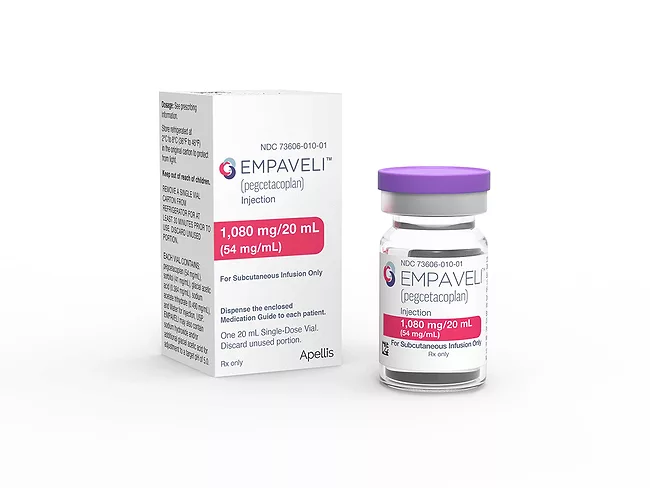
Now that Apellis Pharmaceuticals Inc.’s Empaveli pegcetacoplan has won FDA approval as the first targeted C3 therapy for treating paroxysmal nocturnal hemoglobinuria (PNH), the cost of treating the rare blood disorder is hefty.
Apellis Pharmaceuticals Inc. could receive up to $1.25 billion from Swedish Orphan Biovitrum (Sobi) AB in their collaboration to develop systemic pegcetacoplan, a C3 therapy for treating several rare diseases in hematology, nephrology and neurology.
Apellis Pharmaceuticals Inc.’s CEO, Cedric Francois, said his firm’s phase III study called Pegasus testing pegcetacoplan, or APL-2, in paroxysmal nocturnal hemoglobinuria (PNH) “finally established that there is an important unmet medical need in this disease.”