The U.S. FDA has granted emergency use authorization (EUA) to Quanterix Corp.’s SARS-CoV-2 IgG antibody test, which tests blood samples for evidence of recent or prior COVID-19 infection. The test could also be used to measure antibody response to a COVID-19 vaccine. The Simoa Semi-Quantitative SARS-CoV-2 IgG antibody test is indicated for the qualitative and semi-quantitative detection of IgG antibodies to SARS-CoV-2 in human serum and dipotassium EDTA plasma from a venous blood draw.
Thanks to the pandemic caused by the SARS-CoV-2 coronavirus identified in late December 2019, 2020 was the year of COVID-19. It was a year of lockdowns and social distancing, a year of Zoom meetings and virtual conferences, and a year when donning a face mask sometimes came to signify a political rather than health decision. For the biopharma sector, the impact of COVID-19 was wide-ranging, in many cases showing the industry at its best, with the speedy mobilization of scientific efforts that spawned vaccine approvals at record rates and a host of therapeutics making their way through development. But biopharma suffered COVID-19-related setbacks as well, from a negative impact on clinical trials to the increasing politicization of science that could make the industry’s job harder as the world moves hopefully to end the pandemic in 2021. In looking back over the past year, BioWorld has compiled the biggest trends and lessons from the year of COVID-19.
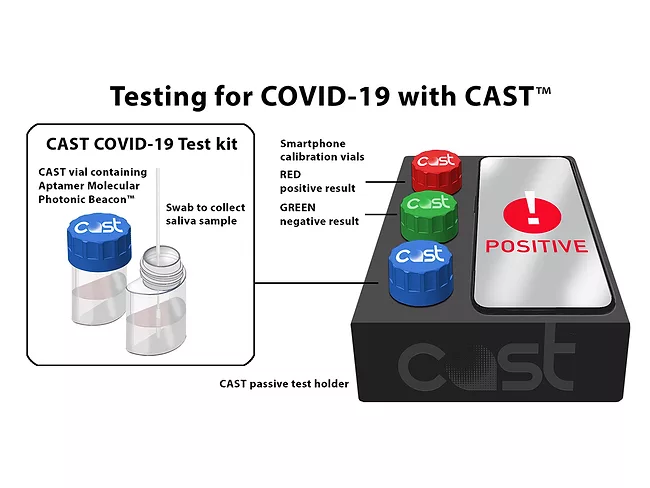
Two-Photon Research Inc. (TPR) has launched a diagnostics platform it said improves coronavirus detection via aptamers, small molecules that change shape when binding to a protein at the surface of the SARS-CoV-2 molecule that causes COVID-19. Light shone onto a vial containing a patient’s saliva and the Aptamer Molecular Photonic Beacon (AMPB) generates negative or positive results that are instantly displayed on a smartphone and stored for planning purposes by public health officials.
It has been a year since Wuhan health authorities first issued a bulletin about a cluster of pneumonia cases of unknown cause, first bringing what would become the COVID-19 pandemic to the attention of the World Health Organization. Now, a mutation that significantly increases SARS-CoV-2’s transmissibility has been detected in the U.S. On Dec. 29, Colorado public health authorities reported the first known case of infection with the SARS-CoV-2 VUI 202012/01 (Variant Under Investigation, year 2020, month 12, variant 01), also called B.1.1.7, variant in the U.S. The patient in question, a male in his 20s, has not traveled internationally, indicating that the variant is already circulating more widely in the U.S.
Coagulo Medical Technologies Inc. raised $6.5 million in financing to accelerate delivery of its precision-medicine coagulation diagnostics platform. 20/20 Healthcare Partners led the investment with participation from Sands Capital, Good Growth Capital, IAG Capital Partners, and private investors. The company also received funding through a Small Business Innovation Research (SBIR) grant from the National Science Foundation to develop a COVID-19-related coagulation test.
LONDON – A huge row has broken out in the U.K. about the accuracy and utility of COVID-19 lateral flow tests (LFT) in screening asymptomatic people, as a pilot field study indicated sensitivity is less than 40%, and a nationwide roll out already is in train. At present 116 areas of the country are due to implement community testing from next month, health care workers are due to be handed personal LFT supplies to test themselves twice a week, and the government is about to mandate use of the tests in schools after Christmas.
Regulatory snapshots, including global submissions and approvals, clinical trial approvals and other regulatory decisions and designations: Distalmotion, Inex Innovate, Quanterix.