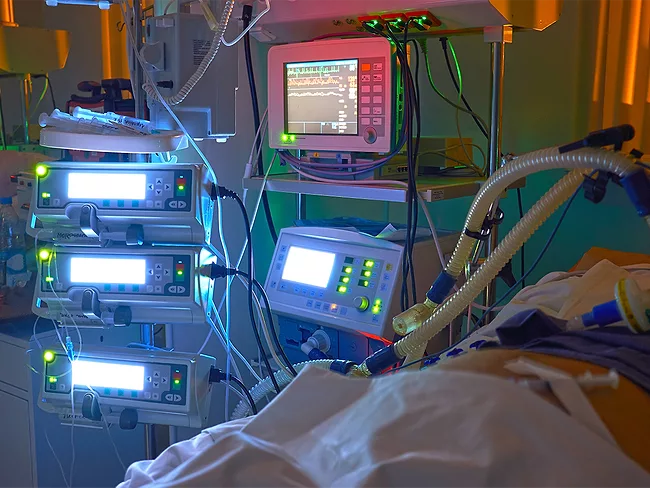
The U.S. FDA has granted emergency use authorizations (EUAs) to Baxter International Inc. for its HF20 Set and ST Set used in continuous renal replacement therapy (CRRT) during the COVID-19 pandemic. The two sets are intended for use with the company’s Prismaflex or Prismax CRRT monitors.
The COVID-19 pandemic has sparked some innovation in testing, but not all that innovation has made it to market. Michael Mina, an assistant professor of epidemiology at the Chan School of Public Health at Harvard University, said on an Aug. 7 conference call that the U.S. FDA’s “archaic view” of testing is impeding the use of paper strip tests he said would turn the tide in the effort to contain the pandemic.
Developers of tests for the SARS-CoV-2 virus have gained a tremendous amount of experience in a very small amount of time, and of all the media for sampling, saliva offers the easiest route for test administration. The U.S. FDA’s Tim Stenzel said on the Aug. 5 testing town hall, however, that the FDA and developers have discovered that this is an extremely difficult medium to work with.
The U.S. FDA gave an emergency use authorization (EUA) to the first semi-quantitative antibody test from Siemens Healthineers AG for the SARS-CoV-2 virus. This test, known as the SARS-CoV-2 IgG (COV2G) antibody test, could potentially be used repeatedly over time to assess relative levels to gauge potential immunity.
The U.S. FDA has nudged the emergency use authorization (EUA) program forward once again, this time with a template for applications for tests that can be performed entirely at home, in the office and at schools. FDA Commissioner Stephen Hahn said in an accompanying statement that tests of this sort “will be a game-changer in our fight against COVID-19 and will be crucial as the nation looks toward reopening.”
The U.S. FDA has rewritten the emergency use authorization (EUA) for the Laboratory Corp. of America Holdings Inc. (Labcorp) COVID-19 polymerase chain reaction (PCR) test to allow for diagnostic testing of those who are asymptomatic and those who have no reason to suspect they are infected with the SARS-CoV-2 virus.
The question of screening for the COVID-19 pandemic continues to absorb the interest of both the U.S. FDA and test developers, and Tim Stenzel, director of the FDA’s Office of In Vitro Diagnostics and Radiological Health (OIR), said in a July 22 webinar that the FDA is “very interested” in a fingerstick test at the point of care for screening purposes, adding that the agency sees any such applications as a priority.
The U.S. FDA announced July 18 that it has granted an emergency use authorization (EUA) to Quest Diagnostics Inc. for the company’s real-time, reverse transcriptase polymerase chain reaction test for the SARS-CoV-2 virus in a development that FDA commissioner Stephen Hahn described as “an important step forward.”
The next phase of testing for the COVID-19 pandemic will hopefully include the roll-out of tests for neutralizing antibodies for the SARS-CoV-2 virus, but there are some roadblocks. The FDA’s Tim Stenzel said the agency has a limited amount of information to offer regarding emergency use authorizations for these tests, a predicament that might not resolve until several applicants are in and the agency can see some information that will aid in development of performance and validation standards.
Electrocore Inc. has snagged an emergency use authorization (EUA) from the U.S. FDA for use of its Gammacore Sapphire CV noninvasive vagus nerve stimulation (nVNS) to acutely treat asthma exacerbations in known or suspected COVID-19 patients. The hand-held therapy can be used at home and in a health care setting.