Bridgebio Pharma Inc. is going back to the Bristol Myers Squibb Co. (BMS) well to restore its stalled momentum as the two companies have supercharged their July 2021 collaboration to develop an SHP2 inhibitor. Bridgebio could receive up to $905 million, including an up-front payment of $90 million plus $815 million in milestone and royalty payments, expected to be in the low- to midteens, in its new BMS collaboration to develop and commercialize BBP-398 in oncology.
Bristol Myers Squibb Co. has announced long-term data from its closely watched psoriasis pill, deucravacitinib, which it hopes will supplant Amgen Inc.’s blockbuster, Otezla (apremilast), as the main oral therapy for the disease.
Privately held Amphista Therapeutics Ltd. has cut massive deals with two biopharma giants, Merck KGaA and Bristol Myers Squibb Co. (BMS), that together could bring the company up to $2.25 billion. The companies will use Amphista’s Eclipsys platform to generate protein degrader-based therapeutics. Merck is looking to discover and develop small-molecule protein degraders for treating cancer and immune disease. Indications in the BMS deal were not announced.
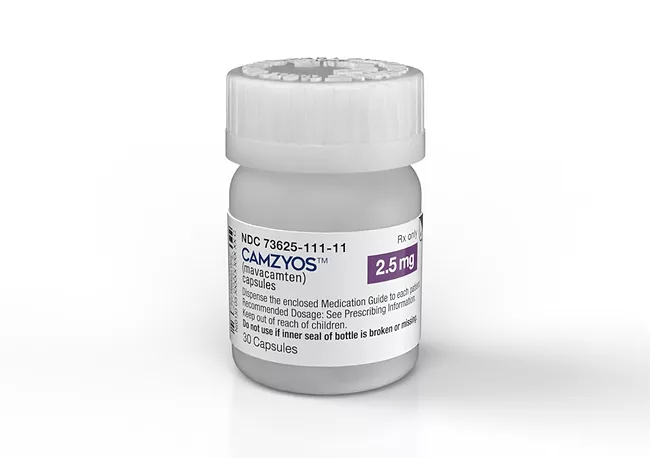
Bristol Myers Squibb Co.’s audacious $13.1 billion 2020 takeover of Myokardia Inc. appears to have paid off with U.S. FDA approval of the drug at the heart of the deal, mavacamten. The medicine, a cardiac myosin inhibitor for treating adults with obstructive hypertrophic cardiomyopathy (HCM), will be marketed under the brand name Camzyos.
Pharmaceutical agents took center stage in Washington on the first full day of the 2022 scientific sessions of the American College of Cardiology, such as an April 2 presentation on the use of the mavacamten for obstructive hypertrophic cardiomyopathy (OHC). Milind Desai of the Cleveland Clinic said 16-week data for this cardiac myosin inhibitor showed well in reducing heart failure class status, but there are data arising from studies in China which suggest that radiofrequency (RF) ablation might also work for these patients.
Roche Diagnostics International Ltd. is joining forces with Bristol Myers Squibb Co. (BMS) to develop two new digital pathology algorithms to support cancer assay use in clinical trials. Roche Digital Pathology will create an artificial intelligence (AI) based image analysis algorithm to assist pathologists in interpreting the company’s FDA-approved Ventana D-L1 (SP142) assay for urothelial carcinoma patients. BMS will use the algorithm to generate biomarker data from clinical trial samples.
Bristol Myers Squibb Co.’s relatlimab will hit the market as the first U.S. FDA-approved LAG-3 inhibitor, cleared by the agency for use in a fixed-dose combination with Opdivo (nivolumab) to treat adult and pediatric patients with unresectable or metastatic melanoma. The approval, a day ahead of the March 19 FDA target date, adds another type of immune checkpoint inhibitor to the oncology arsenal, which already includes drugs targeting PD-1/PD-L1 and CTLA4.
Volastra Therapeutics Inc., dedicated to taking aim at chromosomal instability (CIN) to design cancer drugs by way of its CINtech platform,, scored a potential $1 billion-plus agreement with Bristol Myers Squibb Co. (BMS) to find synthetic lethal targets as drug candidates.
Big pharma sponsors of clinical trials in Ukraine are putting studies on hold in Russia, Ukraine and Belarus as the conflict continues into its third week. As revealed by BioWorld last week, hundreds of clinical trials were being conducted in the two countries at the time Russian President Vladimir Putin gave orders to invade Ukraine on Feb. 20.
Four years after Bristol Myers Squibb Co.’s (BMS) $1.85 billion investment in Nektar Therapeutics Inc., the pair’s collaboration has stumbled mightily with a phase III failure. A first analysis their melanoma study, PIVOT IO-001, showed it missed three primary endpoints. The study of interleukin-2-targeting NKTR-214 (bempegaldesleukin) combined with Opdivo (nivolumab) compared to Opdivo monotherapy as a first-line treatment for previously untreated, unresectable or metastatic melanoma did not meet the primary endpoints of progression-free survival and objective response rate.