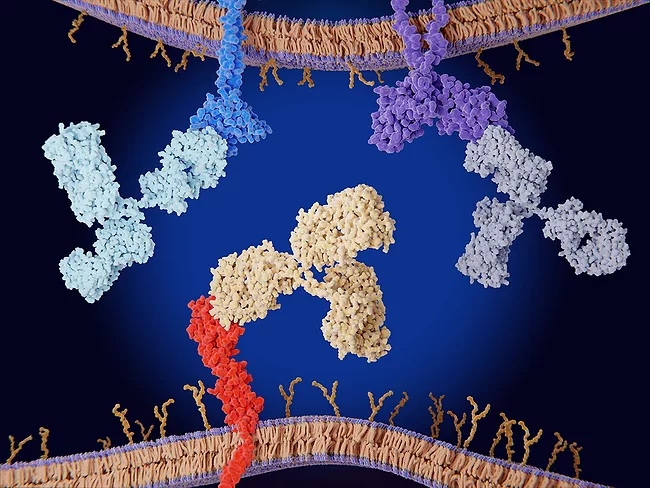
The rough ride presaged by briefing documents came to pass for GSK plc with the drug first approved by the U.S. FDA as Blenrep (belantamab mafodotin, bel-maf), as the agency’s Oncologic Drugs Advisory Committee (ODAC) appraised the possibility that the antibody-drug conjugate could return to market for relapsed/refractory multiple myeloma (r/r MM).
As the July 23 PDUFA date nears for GSK plc’s Blenrep (belantamab mafodotin), the U.S. FDA’s Oncologic Drugs Advisory Committee will decide July 17 on whether available data justify the return to market of the antibody-drug conjugate as a therapy for relapsed/refractory multiple myeloma, and briefing documents made public ahead of the meeting laid out the issues.
The FDA’s Oncologic Drugs Advisory Committee (ODAC) met for what chairperson Christopher Lieu called, at the end, “an incredibly long day” to decide whether approval of immune checkpoint inhibitors should be restricted in accordance with expression levels of PD-L1.
By a unanimous 12-0 vote, the U.S. FDA’s Oncologic Drugs Advisory Committee concluded that new evidence support the use of minimal residual disease (MRD) as an accelerated approval endpoint in multiple myeloma (MM) clinical trials. The FDA will now consider the recommendation, which, if incorporated into future studies, could dramatically shorten some drug developer timelines and offer more options for treating the aggressive bone marrow cancer.
The U.S. FDA thinks using minimal residual disease as an endpoint for accelerated approval in new therapies to treat multiple myeloma (MM) might just be an idea whose time has come. The FDA now wants to know what its Oncologic Drugs Advisory Committee thinks about it, so the agency has convened a meeting of the committee for a deep dive into the subject on April 12.
Following the recommendation of its Oncology Drugs Advisory Committee, the U.S. FDA approved U.S. Worldmeds LLC’s eflornithine 192-mg tablets for use as a maintenance therapy in patients with high-risk neuroblastoma. Branded Iwilfin, the specific, irreversible inhibitor of ornithine decarboxylase previously known as DFMO, is expected to be available in the coming weeks.
From the start of the Nov. 16 Oncologic Drugs Advisory Committee meeting, the U.S. FDA made it clear that withdrawing Acrotech Biopharma Inc.’s peripheral T-cell lymphoma drugs, Folotyn (pralatrexate) and Beleodaq (belinostat), from the market until a long-overdue confirmatory trial is completed is not an option given the current treatment landscape.
If everything goes according to the current plan, the U.S. FDA would get the final report of a confirmatory trial for Acrotech Biopharma Inc.’s Folotyn (pralatrexate) and Beleodaq (belinostat) in 2030 – more than two decades after Folotyn received accelerated approval to treat relapsed or refractory peripheral T-cell lymphoma and 16 years after Beleodaq was granted accelerated approval for the same indication.
As it continues its crackdown on accelerated approval, the FDA continues to stress that successfully completing confirmatory trials should be the top priority for sponsors of drugs that enter the U.S. market via accelerated approval.
The dark cloud of what the U.S. FDA called potential “systemic bias” rained on Amgen Inc.’s bid for full approval of Lumakras (sotorasib), a KRAS-G12C inhibitor that was granted accelerated approval in May 2021 for locally advanced or metastatic non-small-cell lung cancer after at least one systemic therapy.