As it continues its crackdown on accelerated approval, the FDA continues to stress that successfully completing confirmatory trials should be the top priority for sponsors of drugs that enter the U.S. market via accelerated approval.
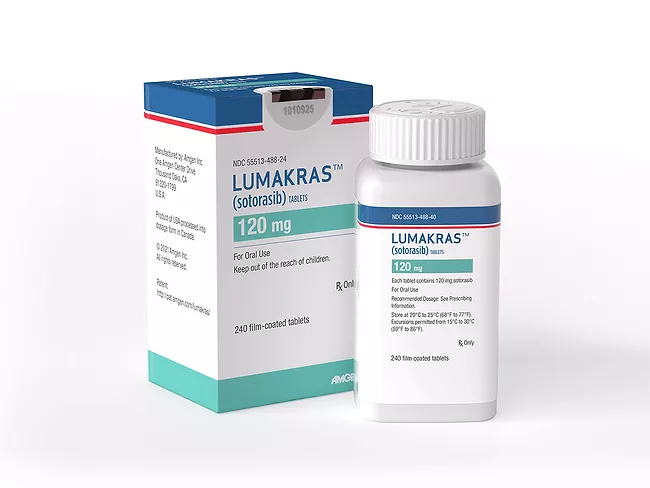
The dark cloud of what the U.S. FDA called potential “systemic bias” rained on Amgen Inc.’s bid for full approval of Lumakras (sotorasib), a KRAS-G12C inhibitor that was granted accelerated approval in May 2021 for locally advanced or metastatic non-small-cell lung cancer after at least one systemic therapy.
Bad news for Amgen Inc. could mean upside for Mirati Therapeutics Inc., though the meeting of the U.S. FDA’s Oncologic Drugs Advisory Committee (ODAC) has yet to tell the tale regarding Lumakras (sotorasib), the former’s KRAS-G12C inhibitor.
After considering the evidence, the U.S. FDA’s Oncologic Drugs Advisory Committee (ODAC) voted 14-6 Oct. 4 that the data from a single external-controlled trial and well-established preclinical animal models present sufficient evidence to demonstrate that US Worldmeds LLC’s DFMO (eflornithine) improves event-free survival in pediatric patients with high-risk neuroblastoma.
For the second time in two weeks, the extent of regulatory flexibility will be at the heart of a U.S. FDA advisory committee meeting. The Oct. 4 meeting of the Oncologic Drugs Advisory Committee (ODAC) comes exactly a week after the Cellular, Tissue and Gene Therapies Advisory Committee voted overwhelmingly that the evidence presented for Brainstorm Cell Therapeutics Inc.’s amyotrophic lateral sclerosis drug, Nurown (debamestrocel), didn’t meet the agency’s flexibility standard. If the FDA’s briefing document for the ODAC meeting is anything to go by, the outcome for US Worldmeds LLC’s eflornithine, also known as DFMO, could be more positive, even though once again the agency is asking if the evidence from a single trial, along with supportive data, is sufficient.
Given the advances being made in cancer treatments, it’s time to move beyond the maximum tolerated dose (MTD) to dose-optimization trials for targeted therapies, the U.S. FDA said in a new draft guidance.
The U.S. FDA’s Oncologic Drugs Advisory Committee (ODAC) took up the matter of Oncopeptides AB’s long-storied multiple myeloma (MM) drug, Pepaxto (melphalan flufenamide), and briefing documents ahead of the meeting – which provided little cause for optimism – proved predictive of ODAC’s vote. Shares of Oncopeptides (Stockholm:ONCO) have dropped more than 64% over the past five days as investor jitters worsened.
Emphasizing April’s vote of concern about the safety of PI3K inhibitors, the U.S. FDA’s Oncologic Drugs Advisory Committee said privately held Secura Bio Inc.’s Copiktra (duvelisib) is more of a hindrance than a help. The adcom voted 8-4 on Sept. 23 that it sees a detriment in overall survival (OS) and some other safety issues that were revealed in newly updated data for the cancer treatment. Approved in 2018 for treating adults with relapsed or refractory chronic lymphocytic leukemia or small lymphocytic lymphoma after at least two prior therapies, Secura argued that its data continue to show a statistically significant and clinically meaningful benefit in OS and also in progression-free survival.
Although it wasn’t a shutout, Spectrum Pharmaceuticals Inc. didn’t get the support it needed from a U.S. FDA advisory committee Sept. 22 for its non-small-cell lung cancer candidate, poziotinib, which it has proposed marketing as Pozenveo.
The fate of three cancer drugs, and possibly the future financial health of their sponsors, could be on the line Sept. 22 and 23 as the U.S. FDA’s Oncologic Drugs Advisory Committee (ODAC) takes a hard look at the safety-efficacy data for Spectrum Pharmaceuticals Inc.’s Pozenveo, Oncopeptides AB’s Pepaxto and Secura Bio Inc.’s Copiktra. First up in the triple-header is Pozenveo (poziotinib), which is seeking accelerated approval as a second-line treatment for patients with locally advanced or metastatic non-small-cell lung cancer harboring HER2 exon 20 insertion mutations confirmed by an FDA-approved test.