A company launched by Alphabet Inc.’s Deepmind in 2021, Isomorphic Labs Ltd., entered its first biopharmaceutical partnerships to discover small-molecule therapeutics with Eli Lilly and Co. and Novartis AG in deals worth $1.75 billion and $1.24 billion, respectively.
Proteome analysis with artificial intelligence has made it possible to create a catalog of all possible missense mutations in the human genome to predict diseases.
Proteome analysis with artificial intelligence has made it possible to create a catalog of all possible missense mutations in the human genome to predict diseases. The new Alphamissense tool from the technology company Google Deepmind, available online, will allow scientists to refine diagnoses and design more tailored treatment strategies for patients suffering from pathologies associated with these variants.
Researchers have identified a druggable pocket on the phosphatase Wip1, which regulates the tumor suppressor TP53 as well as DNA damage repair proteins. The work, which was published in Frontiers in Molecular Biosciences on April 18, 2023, by researchers from the University of Pennsylvania, could lead to therapeutics targeting Wip1. And the computational deep learning methods used to identify the pocket are broadly useful for identifying what the authors call “cryptic” pockets.
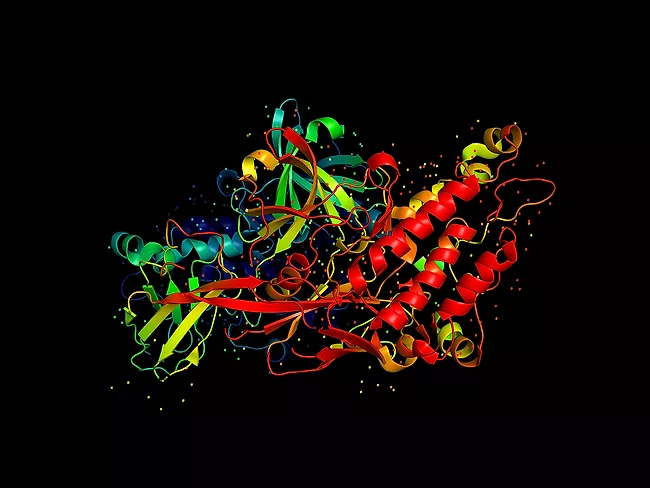
It is now possible to look up the 3D structure of every known protein following the latest release of Alphafold, an open database run in partnership by Deepmind, the London-based artificial intelligence company owned by Google parent Alphabet and the European Molecular Biology Laboratory’s European Bioinformatics Institute in Cambridge, U.K.
Artificial intelligence is moving further into drug discovery with the launch of Charm Therapeutics Ltd., which arrives on the scene with a $50 million series A round.
Researchers at Google AI company Deepmind and the European Molecular Biology Laboratory/European Bioinformatics Institute have developed and published an open-access database with predicted structures of 98.5% of proteins in the human proteome.
LONDON – The Google artificial intelligence company Deepmind has developed an algorithm that can predict the 3D structure of a protein from its amino acid sequence, making it possible to solve the structures of proteins, such as G-protein coupled receptors (GPCRs), which are a mainstay of drug targeting but whose structure is challenging to determine with current methods.
Artificial intelligence (AI) is better than humans at pattern recognition within images and other densely complex datasets. That fact has long been expected to translate into meaningful change in the way we interpret health care data, but beyond a few early exceptions that is not yet the case. Now, the research is starting to amass that demonstrates the real potential for machine learning to significantly improve diagnostics and treatment.
Concussion and traumatic brain injury (TBI) are serious public health problems, but they can be tricky to diagnose, with symptoms sometimes not presenting for days or weeks following a head injury. Abnormal eye movement can indicate a TBI, but traditional "follow my finger" screenings won't pick up more subtle changes in vision. Artificial intelligence (AI) could improve diagnosis by measuring deficits in certain eye movements that occur with a TBI. In a study published online July 25, 2019, in the journal Concussion, Bethesda, Md.-based Righteye Inc.'s FDA eye-tracking technology not only identified but scaled the severity of TBIs by measuring horizontal and vertical saccades, rapid eye movements between fixed points.