In the Biohaven Pharmaceutical Holding Co. Ltd. and Pfizer Inc. collaboration to commercialize Nurtec ODT (rimegepant) outside the U.S., Biohaven will receive tiered double-digit royalties on ex-U.S. net sales as well as milestone payments of up to $1.24 billion. The target: more than 1 billion migraine sufferers worldwide with lots of clinical competition.
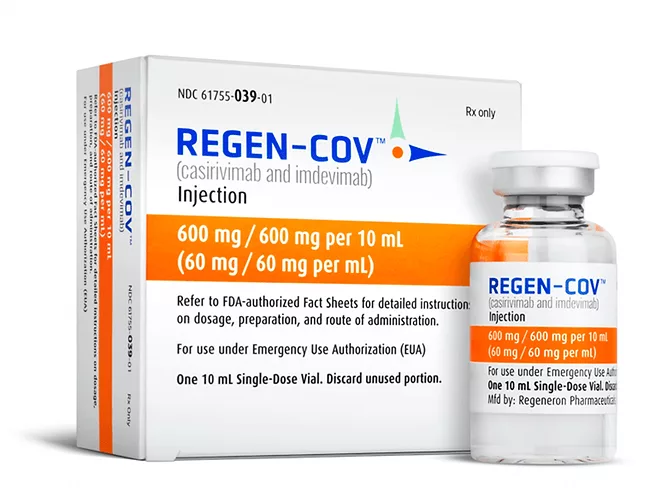
New positive phase III study results for Regeneron Pharmaceuticals Inc.’s COVID-19 monoclonal antibody cocktail show a single dose reduced the risk of contracting the virus by 81.6% during a two- to eight-month follow-up period. The strong data go along with Pfizer Inc.’s recent positive results for its oral antiviral, Paxlovid, hinting that COVID-19 therapeutics could begin cutting into powerful mRNA vaccine margins from Pfizer Inc.-Biontech SE and Moderna Inc.
Just a day after the world's first approval of Merck & Co. Inc.'s oral antiviral for COVID-19 positioned it to offer a new way to keep Britons at high risk of severe disease out of the hospital, Pfizer Inc. is stopping a phase II/III trial of its oral antiviral, Paxlovid, early for "overwhelming efficacy" in a similar group. Interim results showed that combining the drug, also known as PF-07321332, with ritonavir reduced the risk of hospitalization or death for adults with mild to moderate COVID-19 but at high risk of severe disease by 89% vs. placebo.
A few hours after the U.S. CDC Advisory Committee on Immunization Practices’ Nov. 2 recommendation to allow children ages 5 through 11 to be administered Pfizer Inc. and Biontech SE’s COVID-19 vaccine, Comirnaty (tozinameran), the agency’s director, Rochelle Walensky, endorsed the recommendation. The recommendation came as the World Health Organization (WHO) expanded the COVID-19 vaccines it recommends in the fight against the pandemic by endorsing Bharat Biotech International Ltd.’s Covaxin.
In a move that had been expected, the CDC’s Advisory Committee on Immunization Practices unanimously recommended the Pfizer Inc.-Biontech SE COVID-19 vaccine as safe and beneficial for children ages 5 through 11. The recommendation, coming from a 14-0 vote, is the committee’s way of reassuring the American public that the vaccine is safe, according to committee member Beth Bell, clinical professor in the School of Public Health at the University of Washington in Seattle.
An ongoing evaluation of heart muscle inflammation risk, a key concern with mRNA COVID-19 vaccines globally, could delay through January 2022 completion of an FDA review of Moderna Inc.'s vaccine in adolescents 12 to 17 years of age. The side effect, called myocarditis, has been a particular concern with regulators, especially for adolescents and young men.
The FDA has granted emergency use authorization (EUA) to the COVID-19 vaccine created by Pfizer Inc.-Biontech SE for use in children ages 5 through 11. This is the first EUA for a COVID-19 vaccine to be awarded for this group of roughly 28 million children in the U.S. and it comes after weeks of lengthy debate among experts about the wisdom of targeting the young demographic.
The FDA’s Vaccines and Related Biological Products Advisory Committee (VRBPAC) voted 17-0, with one abstention, that the benefits of Pfizer Inc.-Biontech SE pediatric formulation of its two-dose COVID-19 vaccine outweigh its risks for children ages 5 through 11. Many of those votes came with caveats, as the VRBPAC members struggled with the unknowns of the vaccine and the fear that schools would mandate its use, even though it would still be considered experimental if the FDA grants it an emergency use authorization.
LONDON – A U.K. study following up 32.5 million people for 28 days after their first dose of a COVID-19 vaccine has shown an increased risk of hemorrhagic stroke after receiving the Pfizer Inc./Biontech SE product, and confirmed case reports of an increased risk of developing Guillain-Barré syndrome after the Astrazeneca plc vaccine.
Pfizer Inc. said that, in children aged 5 through 11, the COVID-19 vaccine it co-developed with Biontech SE showed 90.7% efficacy against all variants of concern following two doses. The data were included in briefing documents filed ahead of a full discussion at the FDA’s Vaccines and Related Biological Products advisory committee meeting set for Oct. 26.