BioWorld. Link to homepage.

Clarivate
  • BioWorld
  • BioWorld MedTech
  • BioWorld Asia
  • BioWorld Science
  • Data Snapshots
    • BioWorld
    • BioWorld MedTech
    • Infographics: Dynamic digital data analysis
    • Index insights
    • NME Digest
  • Special reports
    • Infographics: Dynamic digital data analysis
    • Trump administration impacts
    • Under threat: mRNA vaccine research
    • BioWorld at 35
    • Biopharma M&A scorecard
    • Bioworld 2025 review
    • BioWorld MedTech 2025 review
    • BioWorld Science 2025 review
    • Women's health
    • China's GLP-1 landscape
    • PFA re-energizes afib market
    • China CAR T
    • Alzheimer's disease
    • Coronavirus
    • More reports can be found here

BioWorld. Link to homepage.

  • Sign In
  • Sign Out
  • My Account
Subscribe
BioWorld - Sunday, January 11, 2026
Home » Topics » Science

Science
Science RSS Feed RSS

Elderly hands holding broken brain structure

South Korea’s GIST completes preclinical studies for noninvasive Alzheimer’s therapy

Jan. 28, 2022
By Gina Lee
South Korea’s Gwangju Institute of Science and Technology (GIST) has completed a preclinical study for a noninvasive therapy for Alzheimer’s disease. The "ultrasound-based gamma entrainment” technique involves syncing up gamma waves, or brain waves above 30 Hz, with an external oscillation of a given frequency. This happens naturally by exposing a subject to a repetitive stimulus, such as sound, light, or mechanical vibrations.
Read More
Psychiatric disorders illustration

Structure-based psychedelic analogue discovery reported

Jan. 28, 2022
By John Fox
Drugs targeting receptors of the neurotransmitter serotonin (5-hydroxytryptamine [5-HT]) are widely used in neuropsychiatry and some such agents, most notably psilocybin, have shown potential for further drug development, but hallucinogenic effects have limited their clinical use. The findings of a new multicenter Chinese structural pharmacology study may now provide a solid basis for the structure-based design of safe and nonhallucinogenic psychedelic analogues with therapeutic efficacy, the authors reported in the January 28, 2022, edition of Science.
Read More
Brain showing inflammation from multiple sclerosis

Studies identify multiple sclerosis cause and mechanism

Jan. 27, 2022
By Anette Breindl
Two studies published this January by separate research teams have conclusively identified Epstein-Barr virus infection as the cause of multiple sclerosis, and the mechanism by which the immune response to EBV infection triggers an attack on the myelin sheath, the insulation that enables high-speed neuronal transmission.
Read More
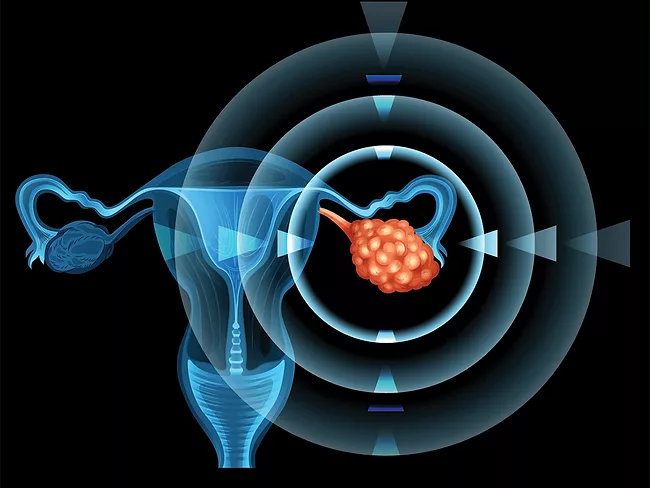
Fallopian tubes, ovaries and uterus

Somatic tissue engineering gives insights into ovarian cancer

Jan. 27, 2022
By Anette Breindl
By using a new method to model ovarian cancer, researchers at Memorial Sloan-Kettering Cancer Center have gained new insights into the role of senescence in therapy response of high-grade serous ovarian cancers.
Read More
Tau neuron illustration

MAP-tau map of interactions shows more than microtubules

Jan. 26, 2022
By Anette Breindl
Tau protein aggregates are present in a group of disorders, collectively termed the tauopathies. Alzheimer's disease is the most common of those disorders, while frontotemporal dementia is most strongly linked to tau. Now, a map of the proteins that interact with tau and how those interactions differ between normal and disease-associated tau protein could give new clues on how the protein causes damage in neurodegenerative disorders, and on how to treat or prevent that damage.
Read More
Multiple sclerosis

Molecular mimicry triggers multiple sclerosis

Jan. 25, 2022
By Anette Breindl
Antibodies to the EBNA1 protein of Epstein-Barr virus can cross-react with glial cell adhesion molecule (GlialCAM), a component of the myelin sheath. The findings are the first to report a mechanism for how viral infections can cause autoimmune disorders.
Read More
Elderly hands holding broken brain structure

Small molecule improves AD neuropathology in mice

Jan. 24, 2022
By John Fox
A novel dual-action small molecule developed by a team led by scientists at Kyungpook National University (KNU) in Daegu, South Korea, has been shown to improve the neuropathological features of Alzheimer's disease (AD) in mice, the authors reported in the Jan. 18, 2022, edition of Proceedings of the National Academy of Sciences.
Read More
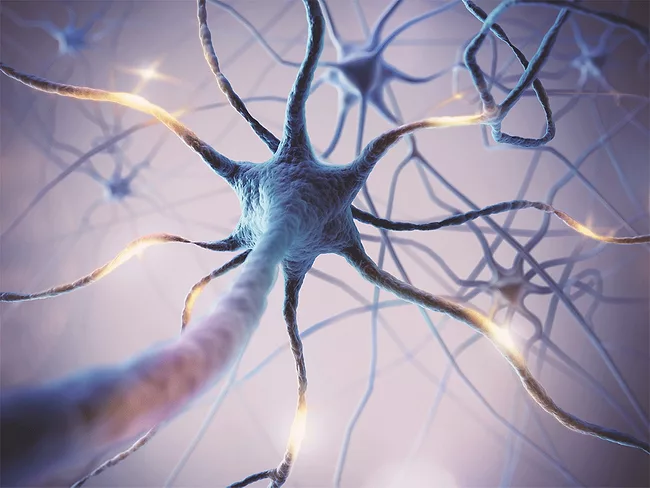
Neural network

Senescent neurons block neurogenesis in mice

Jan. 21, 2022
By John Fox
Destroying senescent cells in the aging stem cell niche, either genetically or pharmacologically using the small-molecule senolytic ABT-263 (navitoclax; Abbvie Inc.), enhanced hippocampal neurogenesis and cognitive function in mice, a Canadian study led by scientists at the University of Toronto has found.
Read More
Virus cells

Targeting PARP could fight cancer-associated virus

Jan. 20, 2022
By Anette Breindl
The enzyme poly [ADP-ribose] polymerase 1 (PARP1) is well known for its role in DNA damage repair, and multiple FDA-approved PARP inhibitors are used to treat BRCA-mutated tumors. Now, researchers at the Wistar Institute have described a role for PARP in regulating the genome of Epstein-Barr virus.
Read More
Amyloid plaques forming between neurons

Amyloid aggregates differ in familial and sporadic AD

Jan. 19, 2022
By Anette Breindl
Investigators have identified structural differences between amyloid-beta (Abeta) aggregates in the postmortem brains of patients with inherited and sporadic Alzheimer's disease (AD), respectively. Moreover, both were different from the aggregates that form when Abeta assembles in vitro.
Read More
Previous 1 2 … 64 65 66 67 68 69 70 71 72 … 188 189 Next

Popular Stories

  • Today's news in brief

    BioWorld
    BioWorld briefs for Jan 9, 2025.
  • Today's news in brief

    BioWorld MedTech
    BioWorld MedTech briefs for Jan. 9, 2026.
  • 3D rendering of antibody drug conjugated with cytotoxic payload

    ADCs’ breakout 2025 and their still-unfinished potential

    BioWorld Science
    Over the course of the year, and continuing into the latest scientific meetings, an extraordinary breadth of new antibody-drug conjugate (ADC) designs was...
  • CAR T cell attacking cancer cells

    Development and characterization of anti-CD19 in vivo CAR T therapy

    BioWorld Science
    Shenzhen Grit Biotechnology Co. Ltd. and Shanghai Vitalgen Biopharma Co. Ltd. recently presented their work to develop and evaluate a novel anti-CD19 in vivo CAR...
  • Preclinical results of anti-ADAMTS13 antibody in acquired von Willebrand syndrome

    BioWorld Science
    The acquired von Willebrand syndrome (AVWS) is a rare bleeding disorder with laboratory findings similar to those of inherited von Willebrand disease. Researchers...
  • BioWorld
    • Today's news
    • Analysis and data insight
    • Clinical
    • Data Snapshots
    • Deals and M&A
    • Financings
    • Newco news
    • Opinion
    • Regulatory
    • Science
  • BioWorld MedTech
    • Today's news
    • Clinical
    • Data Snapshots
    • Deals and M&A
    • Financings
    • Newco news
    • Opinion
    • Regulatory
    • Science
  • BioWorld Asia
    • Today's news
    • Analysis and data insight
    • Australia
    • China
    • Clinical
    • Deals and M&A
    • Financings
    • Newco news
    • Regulatory
    • Science
  • BioWorld Science
    • Today's news
    • Biomarkers
    • Cancer
    • Conferences
    • Endocrine/Metabolic
    • Immune
    • Infection
    • Neurology/Psychiatric
    • NME Digest
    • Patents
  • More
    • About
    • Advertise with BioWorld
    • Archives
    • Article reprints and permissions
    • Contact us
    • Cookie policy
    • Copyright notice
    • Data methodology
    • Infographics: Dynamic digital data analysis
    • Index insights
    • Podcasts
    • Privacy policy
    • Share your news with BioWorld
    • Staff
    • Terms of use
    • Topic alerts
Follow Us

Copyright ©2026. All Rights Reserved. Design, CMS, Hosting & Web Development :: ePublishing