BioWorld. Link to homepage.

Clarivate
  • BioWorld
  • BioWorld Science
  • BioWorld Asia
  • Data Snapshots
    • Biopharma
    • Medical technology
    • Infographics: Dynamic digital data analysis
    • Index insights
    • NME Digest
  • Special reports
    • Infographics: Dynamic digital data analysis
    • Ebola outbreak
    • Hantavirus
    • Trump administration impacts
    • Med-tech outlook 2026
    • Under threat: mRNA vaccine research
    • BioWorld at 35
    • Biopharma M&A scorecard
    • Bioworld 2025 review
    • BioWorld MedTech 2025 review
    • BioWorld Science 2025 review
    • Women's health
    • China's GLP-1 landscape
    • PFA re-energizes afib market
    • China CAR T
    • Alzheimer's disease
    • Coronavirus
    • More reports can be found here

BioWorld. Link to homepage.

  • Sign In
  • Sign Out
  • My Account
Subscribe
BioWorld - Sunday, June 14, 2026
Home » Topics » Science » Bioengineering

Bioengineering
Bioengineering RSS Feed RSS

Gene editing illustration

Next-generation genome editing tools surpass CRISPR milestone

Jan. 4, 2024
By Anette Breindl and Mar de Miguel
Modifying a patient’s DNA is no longer just for science fiction novels. The CRISPR gene editing technique developed by Jennifer Doudna and Emmanuelle Charpentier only took 10 years to reach the market as Casgevy (exagamglogene autotemcel/exa-cel, Vertex Pharmaceuticals Inc.), treating congenital pathologies such as β-thalassemia and severe sickle cell disease. But science does not stop.
Read More
Gene editing illustration
Drug Design, Drug Delivery & Technologies

Next-generation genome editing tools surpass CRISPR milestone

Dec. 28, 2023
By Anette Breindl and Mar de Miguel
Modifying a patient’s DNA is no longer just for science fiction novels. The CRISPR gene editing technique developed by Jennifer Doudna and Emmanuelle Charpentier only took 10 years to reach the market as Casgevy (exagamglogene autotemcel/exa-cel, Vertex Pharmaceuticals Inc.), treating congenital pathologies such as β-thalassemia and severe sickle cell disease (SCD). But science does not stop.
Read More
3D illustration of a eukaryotic cell
Endocrine/Metabolic

Giving yeast cells aging indecision increases longevity

May 4, 2023
By Mar de Miguel
Cells of Saccharomyces cerevisiae, a yeast used as a model for human mitosis, age in two ways. Both genomic instability and the decline of mitochondria cause cells to degenerate and die. The choice of one type or another depends on a network of genes that can be adjusted by bioengineering.
Read More
Ocular

Gene editing restores vision in mice with retinitis pigmentosa

March 23, 2023
A modification of the CRISPR technique has made it possible to restore vision in mouse models with retinitis pigmentosa (RP). Scientists at the Institute of Visual Neuroscience and Stem Cell Engineering of Wuhan University of Science and Technology developed a new gene-editing tool called PE(SpRY) to edit in vivo a mutation of enzyme phosphodiesterase 6B (PDE6β) and return its function.
Read More
Drug Design, Drug Delivery & Technologies

Synthetic cell junctions allow tissue reconstruction

Dec. 13, 2022
By Mar de Miguel
A combination of bioengineering techniques on normal cell binding proteins could be the method of the future for selective cell binding. Scientists at the University of California, San Francisco (UCSF) have created a synthetic glue based on the expression of membrane receptors to establish the desired connection between cells. The results may be applied in different fields of cell biology or biomedicine, such as regeneration and wound repair, including the nervous system, or cancer.
Read More
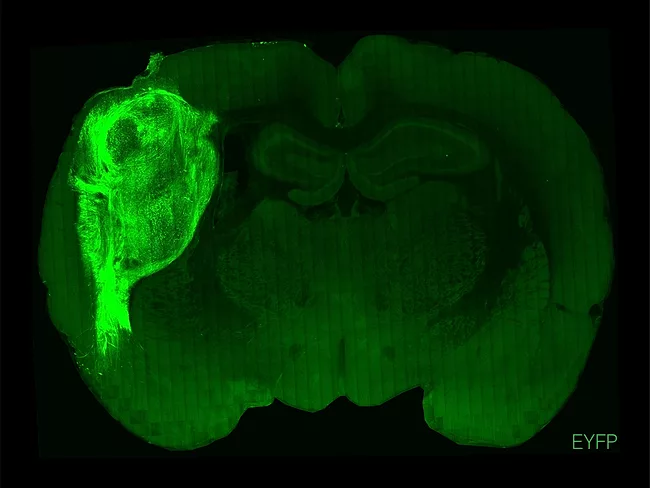
A transplanted human organoid in a section of the rat brain.
Neurology/Psychiatric

Human brain organoids mature after transplantation into rats

Oct. 14, 2022
By Mar de Miguel
Human brain organoids transplanted into rats could be used as an in vivo model for the study of neuropsychiatric diseases. Researchers at Stanford University managed to mature human organoid neurons in the somatosensory cortex of the animal's brain and incorporate them into its neural circuitry.The integration improved the morphological and physiological properties of the transplanted neurons. Compared to those of organoids in a Petri dish, human cells preserved their own identity, and they modified the rat's learned behavior through stimulation and reward experiments.
Read More
A transplanted human organoid in a section of the rat brain.
Neurology/Psychiatric

Human brain organoids mature after transplantation into rats

Oct. 13, 2022
By Mar de Miguel
Human brain organoids transplanted into rats could be used as an in vivo model for the study of neuropsychiatric diseases. Researchers at Stanford University managed to mature human organoid neurons in the somatosensory cortex of the animal's brain and incorporate them into its neural circuitry.The integration improved the morphological and physiological properties of the transplanted neurons. Compared to those of organoids in a Petri dish, human cells preserved their own identity, and they modified the rat's learned behavior through stimulation and reward experiments.
Read More
Previous 1 2 3 Next

Popular Stories

  • Today's news in brief

    BioWorld
    BioWorld briefs for June 12, 2026.
  • News in brief

    BioWorld Asia
    BioWorld Asia briefs for June 9, 2026
  • Blood sample tubes after centrifuge

    Pre-disease plasma signature may help redefine lung cancer risk

    BioWorld
    Researchers have identified a 14-protein blood signature that can predict lung cancer risk as much as five years before diagnosis, and the findings could help...
  • Purple molecules

    Europe’s Alzecure, Orionis in $1B+ deals with Lilly, Novartis

    BioWorld
    Two companies with European ties signed billion-dollar deals with large pharma firms in the last two days to discover and develop molecular glue drugs, as well as...
  • Neck exam

    Ethyreal launches to treat the underlying cause of Graves’, TED

    BioWorld
    Ethyreal Bio Inc. has come out of stealth mode in order to disclose preclinical data for ETHY-001, its monoclonal antibody targeting thyroid stimulating hormone...
  • BioWorld
    • Today's news
    • Analysis and data insight
    • Clinical
    • Data Snapshots
    • Deals and M&A
    • Financings
    • Medical technology
    • Newco news
    • Opinion
    • Regulatory
  • BioWorld Science
    • Today's news
    • Biomarkers
    • Cancer
    • Conferences
    • Endocrine/metabolic
    • Immune
    • Infection
    • Neurology/psychiatric
    • NME Digest
    • Patents
  • BioWorld Asia
    • Today's news
    • Analysis and data insight
    • Australia
    • China
    • Clinical
    • Deals and M&A
    • Financings
    • Newco news
    • Regulatory
    • Science
  • More
    • About
    • Advertise with BioWorld
    • Archives
    • Article reprints and permissions
    • Contact us
    • Cookie policy
    • Copyright notice
    • Data methodology
    • Infographics: Dynamic digital data analysis
    • Index insights
    • Podcasts
    • Privacy policy
    • Share your news with BioWorld
    • Staff
    • Terms of use
    • Topic alerts
Follow Us

Copyright ©2026. All Rights Reserved. Design, CMS, Hosting & Web Development :: ePublishing