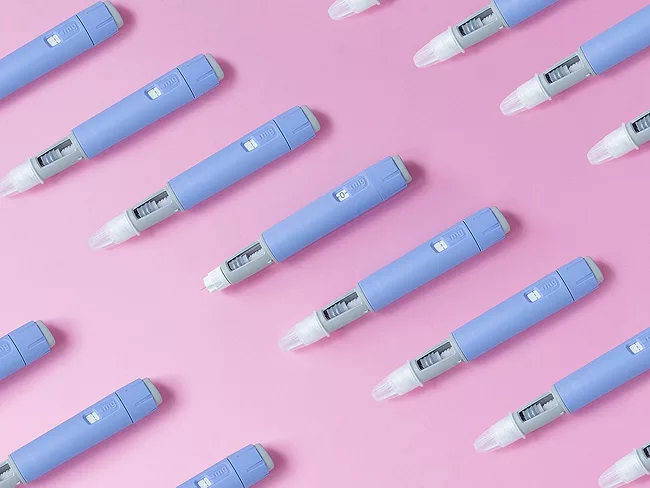
Chinese pharmaceutical and biotech companies are leading development of glucagon-like peptide-1 receptor agonists as Novo Nordisk A/S and Eli Lilly and Co. edge closer to launching blockbuster therapies in China. At the heart of the GLP-1 boom is a nationwide obesity problem driven by a confluence of factors, including the rise of a modern, sedentary lifestyle, according to Clarivate. Despite the rising prevalence of obesity and type 2 diabetes, the gap in obesity therapeutics is “substantial and leaves a solid market opportunity for weight loss drugs,” Karan Verma, principal analyst of healthcare research & data analytics at Clarivate, said.
Novo Nordisk A/S has exercised an option to license a ligand identified by Kallyope Inc. for further development, including as a potential new approach for the treatment of obesity.
Two leading glucagon-like peptide-1 (GLP-1) receptor agonists for obesity and type 2 diabetes – Novo Nordisk A/S’s semaglutide (Wegovy/Ozempic) and Eli Lilly and Co.’s tirzepatide (Mounjaro/Zepbound) – are advancing in China after taking the U.S. market by storm. China represents the world’s largest population of diabetes and obesity patients. Its GLP-1 market, valued at about $1.7 billion in 2023 according to Clarivate, is expected to grow as the number of obesity patients is projected to exceed 500 million by 2033.
Cascade Pharmaceuticals Inc. has disclosed new thyroid hormone receptor β (THRβ) agonists reported to be useful for the treatment of metabolic dysfunction-associated steatotic liver disease (MASLD), hypothyroidism, atherosclerosis and dyslipidemia.
Orsobio Inc. has closed an oversubscribed $67 million series B financing, the proceeds of which will be used to accelerate development of its mitochondrial protonophore portfolio for the treatment of obesity and associated metabolic disorders.
Integrated Nanotherapeutics Inc. has received an award from Breakthrough T1D (formerly Juvenile Diabetes Research Foundation Ltd. [JDRF]) to advance the company’s technology to induce immune tolerance in type 1 diabetes.
Boosting shares by nearly 17% on Sept. 9, phase I data of Terns Pharmaceuticals Inc.’s glucagon-like peptide 1 (GLP-1) receptor agonist, TERN-601, demonstrated it was well-tolerated and led to a statistically significant weight loss across all three doses tested in healthy adults who were obese or overweight.
Immortality and eternal youth have been the stuff of myths and legends from ancient times on. Now, in the 21st century, real studies of current medicine could be applied to repair tissues and organs damaged by age. During the 11th Aging Research & Drug Discovery (ARDD) Meeting held at the University of Copenhagen at the end of August, scientists explained the molecular keys of rejuvenation, as many artists imagined in the past.
 RSS
RSS