In what represents its first patenting, Austin, Texas-based Slipstream Solutions LLC is seeking protection for systems and methods for treating fluid stasis (e.g., edema) that employ an airstream to move static fluid to natural drainage areas such as lymph nodes or ducts.
Scientists from the Australian National University have discovered the gene mutation responsible for causing psoriasis, and the findings could lead to improved diagnosis and treatment for patients with psoriasis and psoriatic arthritis, a chronic inflammatory skin disease. “We were able to identify the gene that could be important in enabling this progression from a skin-only condition to a skin-and-joint condition,” lead study author Chelisa Cardinez told BioWorld.
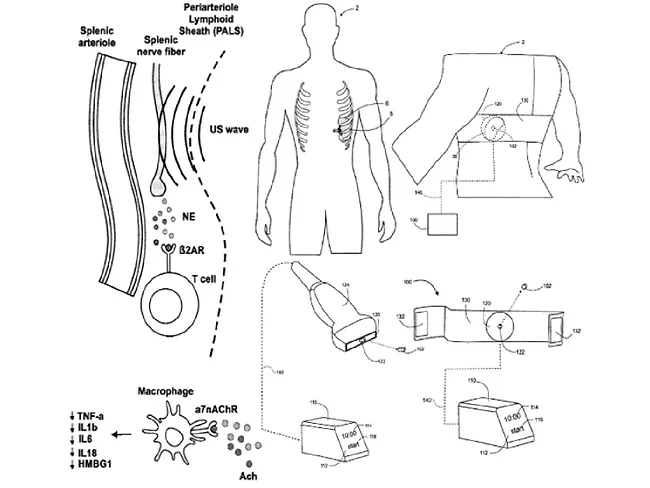
Researchers from Stanford University seek patent protection for an ultrasound-based device which converts electrical energy into acoustic energy to treat inflammatory disorders. The neuromodulator device targets the cholinergic anti-inflammatory pathway (CAP), which regulates the innate immune response to injury, pathogens, and tissue ischemia.
For individuals who develop an unexpected psychosis, there is something to be said for testing them for autoimmune antibodies. And something against. At the 36th Congress of the European College of Neuropsychopharmacology (ECNP) this week, the topic was worth a controversy session, where speakers presented the pros and cons of the approach. Currently used tests have a specificity of 99%. But as Ester Coutinho, consultant neurologist at the University of Coimbra, pointed out, the validity of diagnostic tests depends on the prevalence of the disorder one is looking for as well. Coutinho estimated that autoimmune psychoses account for 1% of psychoses overall.
The broadest view of post-mortem brains in Alzheimer’s disease (AD) has unveiled the genome, transcriptome and epigenome alterations of this neurodegenerative condition. The coordinated research, directed by scientists at the Massachusetts Institute of Technology (MIT), also described new cellular pathways that could help the scientific community design new therapies. Four simultaneous studies published on Sept. 28, 2023, in Cell, presented a brain single-cell atlas of AD, exposed the damage that affects DNA, and described the processes that alter the microglia and dysregulate the epigenome.
A team from Siemens Medical Solutions Inc. presented a new artificial intelligence (AI) model that can predict people’s risk of multiple sclerosis (MS), at the 2023 American Association for Clinical Chemistry (AACC) annual scientific meeting in Anaheim, Calif.
Unlike amphibians, mammals do not regenerate appendages. Except when they do. “If you amputate one of the branches off of the antler [of a reindeer], it will also regenerate,” Jeff Biernaskie told BioWorld. Even without amputation, the antlers of both male and female reindeer regenerate annually, including their skin. That regeneration is “the only large mammal model of true skin regeneration,” he said.
Treating mice with butyrate, a short-chain fatty acid that is normally produced by beneficial gut microbes, prevented anaphylactic shock in allergic mice when they were exposed to peanuts after treatment. It also reduced inflammation in animals with colitis.
South Korea’s Medipost Co. Ltd. is gearing up for phase III trials in the U.S. of its stem cell therapy, Cartistem, an allogeneic human umbilical cord blood-derived mesenchymal stem cell therapy for treatment of knee articular damage in patients with osteoarthritis.
Galvani Bioelectronics Ltd. reported the first patient implanted with its experimental direct splenic nerve stimulation therapy for rheumatoid arthritis (RA). The first-in-human implant is part of a small trial at the NHS Greater Glasgow & Clyde Health Board in Scotland.
 RSS
RSS