The U.K. has become the first country in Europe to approve Leqembi (lecanemab), but as the breakthrough decision was announced, the health technology assessment body NICE said the benefits are too small to justify the cost of providing the Alzheimer’s disease therapy on the National Health Service (NHS).
IGC Pharma Inc. has used its artificial intelligence (AI) modeling to identify the company’s proprietary molecule, IGC-1A, as a potential GLP-1 agonist. The company’s AI model compared IGC-1A and IGC-1C to established drugs such as Ozempic (semaglutide), tirzepatide, retatrutide and metformin, among others, and indicated that they could become effective options for metabolic disorders.
At the ongoing meeting of the American Chemical Society in Denver, F. Hoffmann-La Roche Ltd. has reported the discovery of an orally available and brain-penetrant irreversible asparagine-specific endopeptidase (AEP) inhibitor, RO-7542742, for the potential treatment of neurodegenerative diseases.
The risk of developing multiple sclerosis (MS) is nearly four times as high for women as it is for men. And that relative risk has increased sharply over time. In 1955, women were only slightly more likely than men to develop MS. A research team at the University of Toronto and the Oklahoma Medical Research Foundation (OMRF) has gained new insights into possible causes for this increasing disparity.
Alzheimer’s disease (AD) is characterized by synaptic damage, neuronal loss and cognitive decline caused by the neurotoxic effects of amyloid-β. It is the third most significant challenge to global health nowadays and currently available drugs have limited efficacy.
A week after the U.S. FDA spurned Lykos Therapeutics Inc.’s bid for approval of a therapy in post-traumatic stress disorder (PTSD), shares of Alzamend Neuro Inc. (NASDQ:ALZN) zoomed upward on more news in the indication with a next-generation, cocrystal lithium compound AL-001. Atlanta-based Alzamend’s stock closed Aug. 19 at $5.85, up $3.82, or 188%.
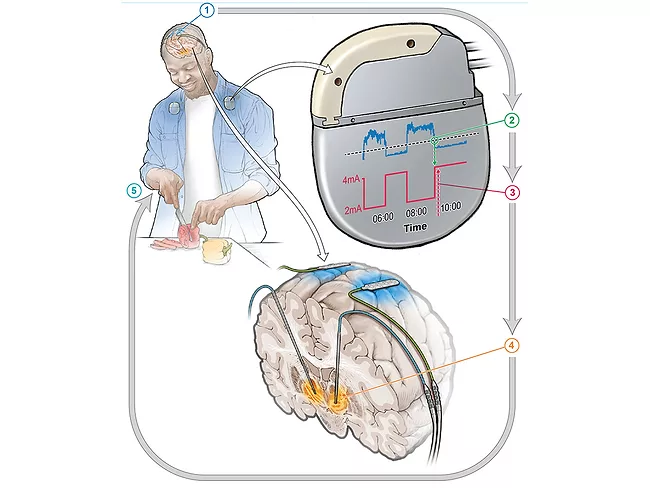
An implanted deep brain stimulator that calibrates its electrical pulses based on changes in brain activity reduced patients’ most bothersome symptoms of Parkinson’s disease 50%, a small feasibility study published in Nature Medicine found.
Shenzhen Crystalo Biopharma Technology Co. Ltd. has divulged short transient receptor potential channel 5 (TRPC5) antagonists reported to be useful for the treatment of anxiety, depression, post-traumatic stress, diabetic nephropathy and focal segmental glomerulosclerosis.
Shanghai Institute of Organic Chemistry has prepared and tested microtubule destabilizers (tubulin polymerization inhibitors) reported to be useful for the treatment of cancer, traumatic brain injury, multiple sclerosis, and Alzheimer’s, Huntington's and Parkinson's disease.
 RSS
RSS