PDC Therapeutics SA has passed the first test of its novel nanocarrier technology, getting approval to move up from the initial dose in the phase I trial of lead product RS-0139, which targets a docetaxel payload to tumors expressing the integrin receptor.
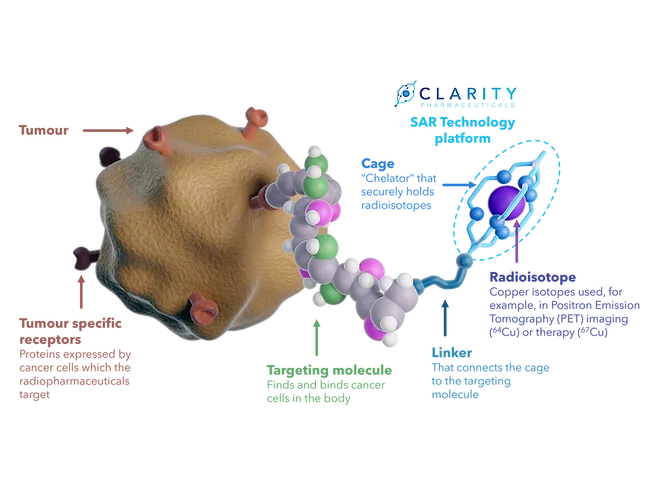
Clarity Pharmaceuticals Ltd. is progressing three of its targeted copper theranostics through the clinic that are based on its sarcophagine technology that securely holds copper isotopes inside a cage-like structure, called a chelator. The SAR technology allows a unique pairing of copper isotopes, copper-64 and copper-67, for both cancer diagnosis and therapy.
After filing patents on a decades-old antipsychotic, Aneurotech BV is laying plans for a U.S. phase IIIb trial of the drug as an adjunctive therapy in major depressive disorder. The study will assess the effects of ANT-01, a low dose of pipamperone, a selective antagonist of both the serotonin 5-HT2A and D4 dopamine receptors, which has been on the market in some countries in Europe and elsewhere for more than 40 years.
The only way to avoid food allergies right now is to stay away from whatever triggers them and, at best, grab some rescue epinephrine in case there’s trouble. Peanut allergies have an FDA-approved treatment, but the remainder of the troublemakers don’t have any therapies. Hoping to change that, Alladapt Immunotherapeutics Inc. closed a $119 million financing to develop its food allergy treatments. The Menlo Park, Calif.-based company’s lead candidate is ADP-101, an oral immunotherapy that is in a phase I/II trial and an open-label extension study of children and adults.
Although there has been huge progress in treatment of cystic fibrosis over the last decade, with Vertex Pharmaceuticals Inc. becoming the first to address the underlying cause of the disease with its Kalydeco (ivacaftor), approved in 2012, there are still many patients who aren’t eligible for treatment.
In the last decade, Bayer AG and Novartis AG have shown that radiopharmaceutical technology can produce marketable drugs, with Xofigo (radium-223 dichloride) and Lutathera (lutetium [177Lu] oxodotreotide), respectively approved for prostate cancer and neuroendocrine tumors.
From 20 years of research on metabolic change as a result of salt intake, Karen Duggan discovered in 2003 that a naturally occurring molecule in the human body, native vasoactive intestinal peptide (VIP), was capable of reversing fibrosis caused by hypertension and other chronic diseases such as diabetes. From that discovery, Vectus Biosystems Ltd. was founded, and the company has developed a new class of mimetic drug candidates and a drug library based on VIP.
Profoundbio Inc. closed a $70 million series A financing round that will see it advance its two lead antibody-drug conjugate (ADC) programs to the clinic. The Suzhou, China, and Woodinville, Wash.-based company has raised a total of more than $138 million in the past two years.
A U.K. biotech is aiming to build a new pipeline around a unique drug delivery system employing a naturally occurring protein called a “nanosyringe” to overcome the technical challenges of delivering therapeutic payloads to target cells. Nanosyrinx Ltd., of Warwick, based its technology on a naturally occurring bacterial toxin mechanism, which produces tiny virus-like particles. The synthetic biology approach has allowed the company to tweak the cellular machinery of bacteria to produce these nanosyringes loaded with drugs.
 RSS
RSS