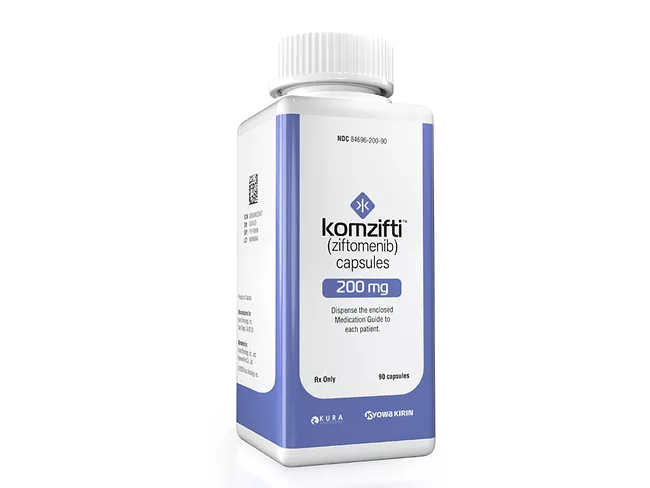
The U.S. FDA gave the thumbs up to Kura Oncology Inc./Kyowa Kirin Co. Ltd.’s selective oral menin inhibitor, ziftomenib, to treat relapsed, refractory (r/r) nucleophosmin1 (NMP1)-mutant acute myeloid leukemia (AML). The approval of the drug, branded Komzifti, came more than two weeks ahead of the Nov. 30 PDUFA date.
Shanghai Henlius Biotech Inc. and Organon & Co. announced Nov. 17 that the U.S. FDA cleared Poherdy (pertuzumab-dpzb) as the first and only interchangeable biosimilar to Perjeta (pertuzumab, Genentech Inc./Roche Holding AG).
Top-line results from a midstage study of Vanda Pharmaceuticals Inc.’s tradipitant hit its primary endpoint by preventing the nausea and vomiting that can be caused by the GLP-1 receptor agonist Wegovy (tirzepatide, Eli Lilly and Co.) in overweight and obese adults. The positive phase II study data prompted Vanda to look at a phase III study of the oral neurokinin-1 receptor antagonist next year.
Aesculap Implant Systems LLC has seen its share of bad news recently, but the company seems to have cleared the legal deck with an agreement to pay $38.5 million per a Nov. 17 announcement by the U.S. attorney’s office for the district of Eastern Pennsylvania.
T-knife Therapeutics Inc. has filed a clinical trial application (CTA) to initiate a phase I trial of TK-6302, a PRAME-targeted T-cell receptor (TCR) T-cell therapy in solid tumors. Pending CTA approval, the ATLAS trial is planned to begin next year.
Over a span of five-and-a-half months this year, 3.5% of the more than 11,000 clinical trials funded by the U.S. NIH had their grants terminated, according to an article published in the Nov. 17 JAMA Internal Medicine. That’s 383 trials that lost funding.
The Medicare Wasteful and Inappropriate Service Reduction (WISeR) proposal is designed to tamp down on waste, fraud and abuse in the Medicare program, but Jeff Wurzberg, a partner at Norton Rose Fulbright LLP, told BioWorld that the contractors developing these AI models have incentives to return non-covered determinations for services.
Exactech Inc., of Gainesville, Fla., decided it will not subject itself to a 10-year corporate integrity agreement with the Office of Inspector General, an understandable move given that the company no longer intends to do business in the U.S. under its old brand.
Akeso Inc. has received clearance from China’s National Medical Products Administration (NMPA) to initiate clinical trials with AK-152 for Alzheimer’s disease.
Fifteen years since the first patient was treated, and after being ditched by two companies, the EMA is recommending approval of Waskyra (etuvetidigene autotemcel), the first gene therapy for treating Wiskott-Aldrich syndrome.
 RSS
RSS