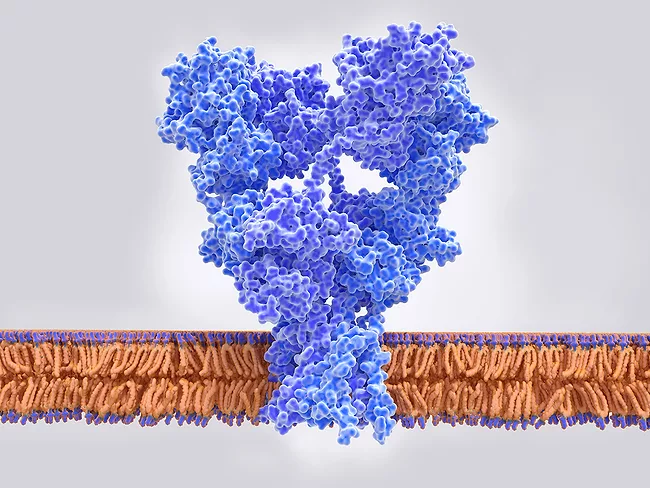
Researchers have discovered that a subunit of the ubiquitin-proteasome system acted independently of the proteasome machinery to regulate AMPA receptors, a type of glutamate receptor, at multiple steps of their life cycle. Published in the May 26, 2023, issue of Science, the findings could point to ways to target AMPA receptors. They are responsible for the majority of excitatory transmission in the central nervous system, and current drugs seeking to influence AMPA-based transmission are “good but they are not great,” Erin Schuman told BioWorld. “This regulatory particle is watching the glutamate receptor at each step.” Schuman is the director of the Max Planck Institute for Brain Research and the paper’s senior author.
Shenzhen Winkey Technology Co. Ltd. has described tetrapeptide derivatives reported to be useful for the treatment of skin inflammation and hyperpigmentation.
Medshine Discovery Inc. has divulged azaspiro compounds acting as leucine-rich repeat kinase 2 (LRRK2; dardarin) inhibitors reported to be useful for the treatment of Parkinson’s disease.
Sialidosis is a lysosomal storage disease caused by mutations in the NEU1 gene, which encodes sialidase neuraminidase 1. These mutations lead to enzyme deficiency and subsequently accumulation of oligosaccharides and sialylated glycopeptides in tissues and body fluids, which in turn lead to cell and organ dysfunction. There are no approved therapies. Three different AAV9 vectors encoding NEU1 were developed and tested by UMass Chan Medical School researchers in the preclinical setting in mice.
The targeted delivery of optimized stem cells directly into injured tissues has been used to maximize efficacy and minimize systemic exposure. Still, despite hundreds of clinical trials evaluating mesenchymal stem cell (MSC) therapy as a treatment, clinical efficacy remains highly variable. Investigators at Case Western Reserve University have developed an optimized combination of cytokines and growth factors applied to MSCs (HXB-319).
NGGT (Suzhou) Biotechnology Co. Ltd. has presented preclinical data on an AAV vector approach that expresses human PAH, rAAV8-PAH, also known as NGGT-002. NGGT-002 has liver tropism and it was codon-optimized for expressing PAH in the liver.
Researchers from Healios K.K. presented preclinical data for HLCN-061, a novel gene-engineered human induced pluripotent stem cell (iPSC)-derived NK cell product being developed for the treatment of solid tumors.
 RSS
RSS