After a week of hype, the most-favored nation (MFN) drug pricing executive order (EO) U.S. President Donald Trump signed May 12 has a lot of bark but little bite, as one analyst put it. Brian Abrahams, head of global healthcare research at RBC Capital Markets LLC, said the EO is unlikely to rattle the biopharma sector, even though it lacked the certainty to completely remove the MFN overhang. “We see reason for relief and, alongside improving FDA clarity and limited tariff risk, expect biopharma to be viewed as increasingly investable,” Abrahams said.
As biopharma companies continue to roll out their first-quarter earnings, Trump administration tariffs remain at the top of investors’ minds. While executives offer their various strategies to appease concerns, the uncertainty prevails, making it difficult to clearly satisfy all of the questions.
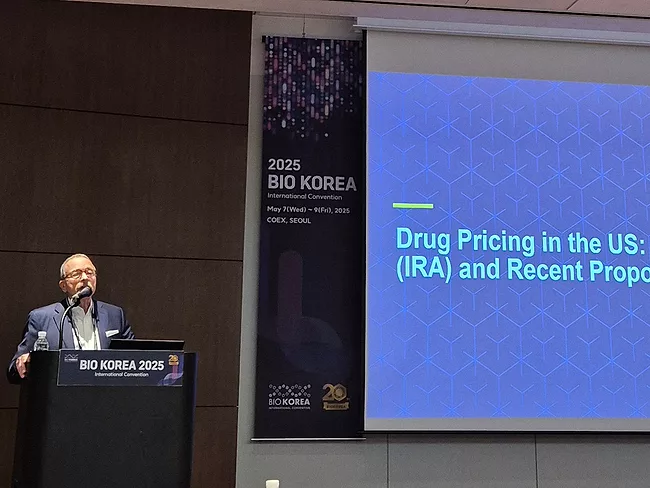
Ongoing policy issues in the U.S., including the Inflation Reduction Act and recent proposals under President Donald Trump’s administration, have wide ranging implications for the global biopharmaceutical industry, speakers at Bio Korea 2025 said May 8, including a heightened need for all biotechs to draft regulatory strategies.
In a throwback to the Obama administration, U.S. President Donald Trump signed an executive order pausing federally funded research using infectious pathogens and toxins that may pose a danger until a safer, more enforceable and transparent policy governing such research can be developed and implemented.
The appointment May 6 of Vinay Prasad as the head of the U.S. FDA’s Center for Biologics Evaluation and Research (CBER) “bodes poorly” for Sarepta Therapeutics Inc.’s development-stage pipeline, said Wainwright analyst Mitchell Kapoor – and Wall Street reflected as much, as the stock (NASDAQ:SRPT) ended that day down 26.6% vs. an XBI drop of 6.6% – this ahead of the after-hours earnings disclosure that pushed the Cambridge, Mass.-based firm down even farther by more than another 20%, with the XBI unchanged.
In an ongoing effort to onshore more of the biopharma supply chain, U.S. President Donald Trump signed an executive order (EO) late May 5 to shorten the time involved in bringing a new manufacturing plant or expansion online and to remove some of the incentives for foreign production of finished drugs and active pharmaceutical ingredients.
Claiming that they’re suffering the consequences of a March 27 directive ordering a mass reduction in force and reorganization throughout the U.S. Department of Health and Human Services (HHS), 19 states and the District of Columbia took their grievances to court.
Echoing President Donald Trump’s justification for reciprocal tariffs, the U.S. Trade Representative’s annual Special 301 Report is a bit more aggressive in tone this year as it calls out trading partners that don't adequately enforce intellectual property rights or that otherwise discriminate against products from foreign companies.
In a paradigm shift from private-sector partners, the U.S. Department of Health and Human Services (HHS) and the NIH announced May 1 the development of Generation Gold Standard, a next-generation, universal vaccine platform that uses a beta-propiolactone-inactivated, whole-virus to target pandemic-prone viruses.
“We are prepared for every scenario, even though we don’t know what some of those are.” That sums up the message from executives of Astrazeneca plc, GSK plc and Sanofi SA, when quizzed during presentations of their first-quarter 2025 results this week, about the fallout if pharmaceuticals they import to the U.S. are subject to tariffs.
 RSS
RSS