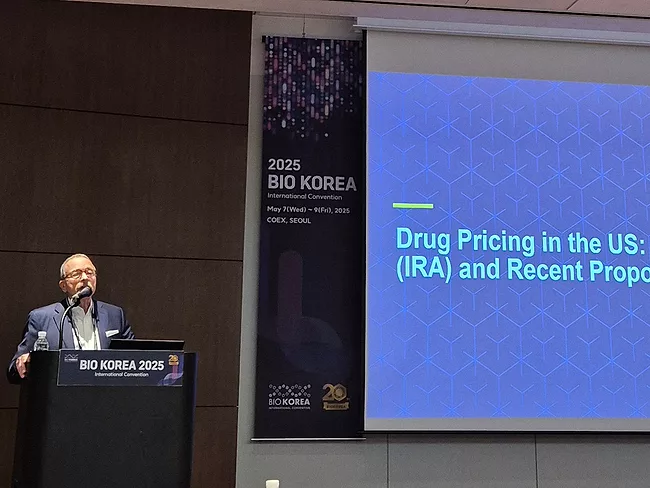
Ongoing policy issues in the U.S., including the Inflation Reduction Act and recent proposals under President Donald Trump’s administration, have wide ranging implications for the global biopharmaceutical industry, speakers at Bio Korea 2025 said May 8, including a heightened need for all biotechs to draft regulatory strategies.
In a throwback to the Obama administration, U.S. President Donald Trump signed an executive order pausing federally funded research using infectious pathogens and toxins that may pose a danger until a safer, more enforceable and transparent policy governing such research can be developed and implemented.
The appointment May 6 of Vinay Prasad as the head of the U.S. FDA’s Center for Biologics Evaluation and Research (CBER) “bodes poorly” for Sarepta Therapeutics Inc.’s development-stage pipeline, said Wainwright analyst Mitchell Kapoor – and Wall Street reflected as much, as the stock (NASDAQ:SRPT) ended that day down 26.6% vs. an XBI drop of 6.6% – this ahead of the after-hours earnings disclosure that pushed the Cambridge, Mass.-based firm down even farther by more than another 20%, with the XBI unchanged.
“We are prepared for every scenario, even though we don’t know what some of those are.” That sums up the message from executives of Astrazeneca plc, GSK plc and Sanofi SA, when quizzed during presentations of their first-quarter 2025 results this week, about the fallout if pharmaceuticals they import to the U.S. are subject to tariffs.
Echoing President Donald Trump’s justification for reciprocal tariffs, the U.S. Trade Representative’s annual Special 301 Report is a bit more aggressive in tone this year as it calls out trading partners that don't adequately enforce intellectual property rights or that otherwise discriminate against products from foreign companies.
In an ongoing effort to onshore more of the biopharma supply chain, U.S. President Donald Trump signed an executive order (EO) late May 5 to shorten the time involved in bringing a new manufacturing plant or expansion online and to remove some of the incentives for foreign production of finished drugs and active pharmaceutical ingredients.
Claiming that they’re suffering the consequences of a March 27 directive ordering a mass reduction in force and reorganization throughout the U.S. Department of Health and Human Services (HHS), 19 states and the District of Columbia took their grievances to court.
April data and first quarter earnings reports show remarkable resilience in med tech, even as other sectors continue to suffer in response to tariffs and changing regulations. Not that tariffs proved insignificant: several companies reported annualized impacts north of half a billion dollars, but fundamentals and increased interest in med tech as a haven gave most players sufficient breathing room to absorb the impact with minimal adjustments.
Echoing President Donald Trump’s justification for reciprocal tariffs, the U.S. Trade Representative’s annual Special 301 Report is a bit more aggressive in tone this year as it calls out trading partners that don't adequately enforce intellectual property rights or that otherwise discriminate against products from foreign companies.
Sen. Amy Klobuchar (D-Minn.) spoke to an industry meeting in Washington and expressed concerns about the situation at the U.S. FDA, but she also blasted the tariffs put in place by the Trump administration as lacking the proper statutory authority.
 RSS
RSS