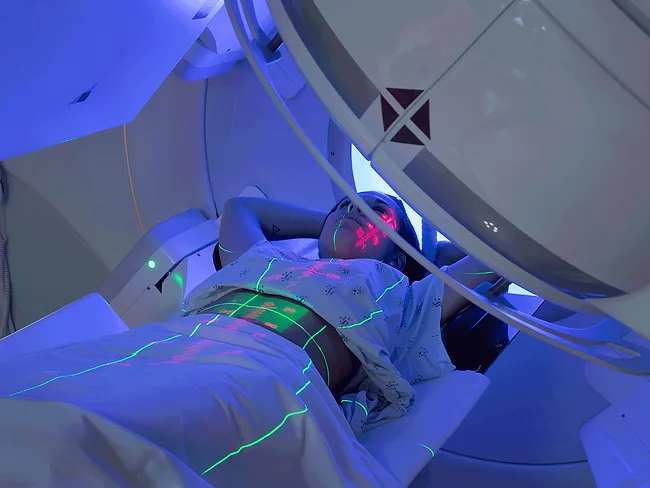
If its challenges can be overcome, radioligand therapy is poised to change the way many cancers are treated. It is also likely to become an example of how scientific advances, once they are translated successfully, can enable further insights in a bench-to-bedside-to-bench loop. David Piwnica-Worms, professor and chair of cancer systems imaging at The University of Texas MD Anderson Cancer Center, predicted that as radioligand therapy expands, many questions will be answered about both radiation biology and the interaction of radiation with the immune system more specifically.
After spending decades developing targeted chemotherapy and bringing a dozen or so compounds into the clinic, Fusion Pharmaceuticals Inc. Chief Scientific Officer Christopher Leamon switched careers to focus on radio-oncology because he saw the need for “a really strong bomb to target cancer to get it to respond.” That was radiotherapy, said Leamon, who was one of the scientific founders of Endocyte Inc., which Novartis AG acquired.
Global interest in radiopharmaceuticals is growing, and some big deals in the space have sparked interest in the last few years. Novartis AG has spent about $6 billion in acquisitions and is seen as the global leader.
The big idea behind radiopharmaceuticals is taking the hallmarks of two cancer therapies – radiology and chemotherapy – and merging them, and this is what makes the technology a disrupter.
U.S. FDA commissioner Robert Califf went to Capitol Hill ostensibly to answer questions about the agency’s budget request for fiscal 2024, but the conversation quickly focused on issues such as baby formula and food supply security.
During the first round of discussion at its two-day hearing on a World Trade Organization proposal to expand the intellectual property (IP) waiver from COVID-19 vaccines to diagnostics and therapies, the U.S. International Trade Commission (USITC) got an earful from both sides of the debate.
Sofinnova Partners launched a new investment strategy focused on digital medicine in a sign that investment in European startups, especially those at the intersection of biology, data and computation is returning. “It cannot be stressed enough that there is a need in the market for this,” said Edward Kliphuis, partner in the Sofinnova Digital Medicine Strategy.
The Biden administration’s budget proposal for the U.S. federal government’s 2024 fiscal year is undergoing the usual vetting in Congress, and one hearing each in the House and Senate suggest the proposal will gain little or no traction on Capitol Hill. However, supporters of the National Institutes of Health (NIH) may be cheered by the fact that one of President Biden’s own party, Rep. Rosa DeLauro (D-Conn.), blasted the proposal for offering only a 2% increase in the NIH budget, a sign that the agency will receive a substantial boost in monies yet again in FY 2024.
The Australian government will deliver $50 million to a new biomedical and med-tech incubator (BMTI) program for health discoveries spanning early-stage drug development through to cutting edge medical devices and evidence-based digital health technologies.
Citing significant implications for patients with advanced Parkinson’s disease, as well as the broader public interest that’s at stake, the U.S. FTC filed an amicus brief in Sage Chemical Inc.’s district court challenge of Supernus Pharmaceuticals Inc.’s strategies to block generic competition of its injectable Parkinson’s drug, Apokyn (apomorphine).